Sunday, 15 March 2009

The Hidden and Neglected Side of Malaysia

Read here for more

"CHOW KIT "

by

Tengku Razaleigh Hamzah

Excerpts:

Last Thursday I visited Rumah Nur Salam, a centre for homeless children in KL’s Jalan Chow Kit area. Rumah Nur Salam is founded and led by the indefatigable Dr Hartini Zainuddin, the daughter of dear departed friend of mine.
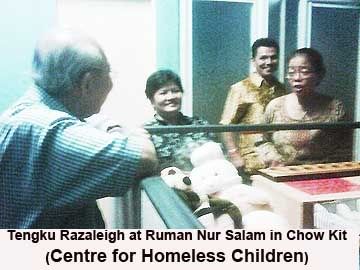

I spent some time with the children and toured the centre, which is, as its name implies, a haven of peace in a very troubled area.

Here, in Chow Kit, in the heart of Kuala Lumpur, less than a kilometre from the Twin Towers and a stone’s thrown from PWTC, life is cheap, drug users shoot up in the back alleys and children wander the streets hungry.

Infants are bought and sold by syndicates, young children are supplied for prostitution and child-pornography.

Hundreds of children are on the streets or homeless. They beg and hustle and sell themselves for sex. They are runaways or abandoned or neglected children, vulnerable to STD and HIV, to drug addiction and to rape and murder. Many among them have no registration papers.


Although they may have been born to Malaysian parents they are “stateless” and therefore ineligible for free inoculation, medical education or education. They are abused and traded with impunity by criminals and corrupt officials because when they disappear it is without trace. They are nobody’s constituency.

Homeless children and street children in Malaysia number in the tens of thousands. They are in Chow Kit, but also in Dengkil, Jinjang, Pantai Dalam, Kepong, Selayang, Subang Jaya, Petaling Street and Pudu and in the bigger towns across the country.

In Sabah and Sarawak, the problem of stateless children is acute.

I sat down to listen to a small circle of community leaders, social workers and volunteers. Some worked with these children. Others worked with other “at risk” groups such as prostitutes, drug users and transsexuals.


What these groups have in common is that they are rejected by society. Many of the leaders come from the very groups they now serve. Having picked themselves up, they immediately felt called to give back to others. The work they do is more than a job. It is a full-time commitment around which they have shaped their lives. Some have served here for decades, walking daily up and down streets that the police recently considered “too unsafe” to keep a beat base open in.

They told me of a set of linked issues: poverty, bigotry, crime, social breakdown and bureaucratic indifference. They spoke about government that could not join the dots between ministries to help people, and of announcements of assistance that amounted to nothing.

Having served a constituency in the depths of Kelantan for forty years, I have seen my share of poverty, but urban poverty is brutal. The family unit is broken. Women and children are left to fend for themselves. The weak are prey to the strong. People are bought and sold like things.

Chow Kit holds up a mirror to our society. It is an image we would rather not see.

The way we treat the weakest among us places the worth of our entire society in the balance. In God’s sight this weighs more than all the wealth we could accumulate.

There is another sense in which urban poverty test us. It is the weathervane of our social and economic ills. Since December, the number of abandoned children has risen dramatically. For the children freshly abandoned to the street, and for their parents, the recession occurred more quickly, and undeniably, than for our leaders.

Behind the evasive and woolly talk we have had about growth figures and fiscal stimuli are the absolutely tangible consequences of our policy decisions in the lives of ordinary people. Economic management, or the lack of it, has disproportionate consequences on the life-prospects of the most vulnerable members of our society.

I came away humbled by the visit. The quiet, day by day heroism of the community leaders and volunteers working to make a difference in Chow Kit was a lesson in leadership as service. I am grateful for all that they and the children shared with me with such open hearts.

RUMAH NUR SALAM - Background

Read here for more

Rumah Nur Salam, which includes Pusat Aktiviti Kanak Kanak, Chow Kit, is a 24 hour activity center and 'safehouse' that wants to provide a 'safe,' healthy and loving environment for all children under the age of 18, living or loitering, in and around the Chow Kit area of KL. Children registered at the center are given food, shelter and are exposed to educational, health and recreational activities and programs that otherwise may not be accessible to them.

On an average day, there are about 30 children who attend a program at the center. Currently, this number increases to around 70 children on weekends. Most who come to the center are under the age of 12, but the number of teenagers who attend a program is on the rise. To date we have over 90 children registered.

Who are these kids? Most of the children are poor and discriminated against and are, from the areas around Chow Kit and the greater parts of KL. They are, for the most part, unable to have their basic needs met and there is little adult supervision. Thus, many children stay on the streets in the middle of the night and are deemed as 'high risk' children.

Rumah Nur Salam is a collaboration project between the Department of Welfare (JKM), Wilayah and Yayasan Salam, Malaysia to assist, protect and address the issues that these children face and to provide a 'safe' zone or sanctuary for them.

The volunteers and staff who were at the Centre soon realized that the children and the community in Chow Kit had many issues that was beyond the scope of the activity.

One of the shocking realization was that come 5.00 pm, many children had nowhere to go to. They were in the streets! Then we realized that children were being exploited in many ways; including physically and sexually. Then there was child trafficking; even parents were selling their own children.

There was an underlying reason for all of these problems and more. The parents of these children we were working with were themselves marginalized and poor. Many of them were drug addicts, sex workers, homeless, to name a few. Besides there were many who were undocumented and/or stateless.

The volunteer based NGO Yayasan Salam Malaysia, realized the need to support the government and took up the challenge. They partnered with JKM. This became a first ever partnership between the government and a non-government organization.

Nur Salam became a reality in 2007.

Programmes at Nur Salam

There are 4 major areas under which the different programs run:

1. PAKK, Chow Kit (10am to 5pm) and Rumah Nur Salam, which runs programs from 5pm till 11pm, every day of the week. We have educational activities and have started with health and recreational programs too, but are short of volunteers to help children with homework supervision ( from 5pm -11pm) and other programs and activities within and outside of the center, on a weekly basis.

2. The Pantry Program, which intends to open from 5pm to 7pm every day of the week. We intend to provide all children who come to the center with at least one hot meal a day, for now. Currently, the Pantry program only runs on Saturdays and Sundays, where we provide dinner meals for 70 children. We are looking for sponsors and donors who can provide dinner for the children during the weekdays.

3. The Overnight 'Guest' Program, will house the first 40 children, under the age of 12 with shelter and a bed if they have no where to sleep for the night or if their parents cannot pick them up before 11pm. The program is strictly on a' first come, first serve' basis because we cannot accommodate more than 20 boys and 20 girls each night. There are wardens for both boys and girls on each floor, to ensure the safety of the children.

4. The Outreach Program is where we work with the Chow Kit community to assist with children in need or at risk and bring them to the center or refer them to the appropriate authorities or NGO bodies who can better assist these children. Among the cases brought to our attention are abandoned children, children of neglect and abuse, teenage pregnancies, sex workers who are also drug addicts with infants and children, runways, children in extreme cases of poverty and danger.

HOW TO MAKE A DONATION:

If you'd like to make a donation, please write your check to Yayasan Salam, Malaysia.

At the back of check, write Rumah Nur Salam and the program that you'd like to donate to:
1. The Activity center

2. The Pantry Program

3. The 'Overnight' Guest Program

4. The Outreach program
Send check to:

Rumah Nur Salam c/o
Yayasan Salam, Malaysia
No 8 Jalan Utara
46200 Petaling Jaya
Selangor, Malaysia
Do provide with a return address and contact name and no for tax exemption purposes. Every donation over RM50 is subject to a tax exemption status.

HOW TO BE A VOLUNTEER

Passionate, committed and eager individuals register with Yayasan Salam, Malaysia. After undergoing an orientation workshop with Salam, volunteers then sign up with the different programs offered to the children at NurSalam.

You can sign up as a volunteer to work and interact with the children for as many hours a week as you like or ( if you have limited time) once a month and/or Nur Salam programs that happen once in 6 months or once a year.

You will be assigned to team leaders and project managers who will assist and support volunteers on site.

Nur Salam is a volunteer driven center that count on people like you to ensure success and provide the children with a better life and better options.

Please contact at:
Yayasan Salam, Malaysia
Tel No: 03-7958 4021
Fax: 03- 7958 4031

Or

Rumah Nur Salam
Tel No: 03-4045 4021 or
Raja Azizan: 017-300 9055

Perak Crisis: Dr. Mahathir Says UMNO/BN Did NOT Follow the Law and Perak Sultan's Decision was AGAINST State and Federal Constitution

Read here for more in Malaysiakini and HERE

Excerpts:

Former Prime Minister Dr Mahathir Mohamad said the political turmoil in Perak was "because they (UMNO/BN) DIDN'T follow the law, instead asked the Ruler to sack the menteri besar. As far as I know, there is NO such provision in the Perak or Federal Constitution."

Dr.Mahathir was answering to a question during his lecture today on “Democracy and the Future Leadership of Malaysia”, organised by the Former People's Representatives Council (Mubarak), at the Tun Hussien Onn Memorial in Kuala Lumpur.

Elaborating, Mahathir said that BN was “terlalu gopoh (too rash)” by not waiting for a state assembly sitting to rid Mohd Nizar Jamaluddin as menteri besar through a vote of no confidence.

Dr. Mahathir said,
"..The problems you see in Perak are because (BN) took some wrong steps. They should have asked the AG (attorney-general) on what is said in the law, then there would have been no problems. But because they didn’t follow the law, now there are all sorts of problems.

Instead, they asked the Sultan to throw out the menteri besar. Some say that the Perak laws allow this, but to my knowledge, this is not the case. Nor does the Federal Constitution (allow this).

This is also dangerous - if the sultan can get rid of a menteri besar or the Agong can get rid of the prime minister - susah kita (we’ll be in trouble).

They (the rulers) have OTHER interests. They DON'T have our political interests in mind.

Because this may be in conflict with the law...the courts may now rule that the Sultan has no right to sack a menteri besar.

We find that people will not comply..because we started on the wrong foot, people are now against us.

It is up to the legal people to decide. What I do know is that for a menteri besar to be removed, it is through a vote of no-confidence (in the state assembly. "

Related Article

INCREASING MALAY ANGER DIRECTING AT MONARCHY AND UMNO'S POLITICS

Read here for more

Excerpts:

Six men, four of them are Malays, were charged in courts nationwide today for insulting the Sultan of Perak on his website. They were angry with the Perak Ruler over his actions that has led to the state’s growing complex constitutional crisis.

One pleaded guilty. Five others claimed trial. The Malay Rulers are as intrinsic to their identity as a Malay as is Islam under the Federal Constitution.

They were angry enough to post insults on the Ruler's website until the authorities had to take action under Section 233 of the Multimedia and Communications Act 1998 for "unwise use of network or network services for making comments, demands, suggestions or communication which are vulgar, false, threatening or disturbing".

These four Malays who were charged also contradicted Umno's declaration that Malays were loyal and supported the Ruler's actions.

Fact is:

  • More Malays were and are angry over the ousting of the Pakatan Rakyat government in Perak than others although the Chinese-dominated DAP had more seats than Pas or PKR.

  • More Malays were also out protesting against the swearing-in ceremony for Pangkor assemblyman Datuk Dr Zambry Abdul Kadir as Barisan Nasional's choice for menteri besar.
While some Umno leaders say the Malays are being exploited or led astray by other races to protest against the Sultan, today's court cases reveal the depth of Malay anger over the perceived injustice in Perak and Umno's intransigence over the years.

Their anger will not dissipate until they get what they want, justice for the elected government in Perak and a government that represents their interests, notwithstanding all the fines to be paid in court, or the rallies and show of support for the royals organised by Umno and their allies.

They not only made history by allegedly insulting the Ruler but also for being the first to be charged under this Act, which provides a maximum fine of RM50,000 or a maximum jail term of one year, or both for those found guilty.

Saturday, 14 March 2009

Judicial Commissioner RIDWAN IBRAHIM Should be SACKED or DEMOTED for Incompetence and an Embarrassment to the Judiciary

Read here article for more

It was another day of absurdity in the annals of the judiciary when Judicial Commissioner Ridwan Ibrahim, incomprehensibly ruled on 11 March 2009 to deny the Speaker of the Perak State Assembly his right of defence.

His ridiculous decision has given the JUDICIARY a BAD name tarnishing its reputation and ruining its image.

On two previous occasions, on 3 and 5 March he had ruled that the Speaker could not have lawyers of his choice to represent him in the suit brought against him.

And on 11 March, he ruled that the Speaker could not even act for himself.

His bewildering decisions have shocked and stunned the legal fraternity and the man in the street.

These decisions went against the grain of natural justice. They were neither supported by legal precedents nor justified by logical reasoning.

Even the lay man is allowed to represent himself. No court has denied him this right to defend himself. Why then this exception in the case of the Speaker?

Justice has not been served by the following decisions of the judicial commissioner which are startling, confusing and baffling:
  • He has refused legal representation of the Speaker’s choice thus going against natural justice;

  • He has refused the Speaker the right to represent himself denying him his inalienable human right;

  • He has refused to allow the Speaker’s leading lawyer to hold a watching brief with speaking rights, thus refusing to hear the Speaker’s side of the case;

  • He has ruled that the Speaker is a public officer when the law does not support his contention;

  • He has issued an indefinite restraining order when he does not have the authority to do so;

  • He has decided to hear the case against the Speaker when the law does not allow him to do so under the Federal Constitution.
The many grave and glaring errors of the judicial commissioner have been very well argued by the former Court of Appeal judge, N H Chan, in his article ‘How to judge the judge’.

In view of the many discrepancies, Aliran urges the Chief Justice to declare a mistrial and dismiss the case in the interest of justice.

Alternatively, there must be a fresh trial presided by a senior judge who is well versed with the law and who understands the principles of justice.

COMMENTARY

Read here for more
I don't understand and have a lot of questions. Did a judicial commissioner err in a ruling that Perak speaker V Sivakumar must only be represented by the state legal adviser?

If yes, doesn’t this reflect incompetency or lapses in professional judgment or something else? How difficult is it to interpret the related law?

If it is simple enough, why not judge it as it is and not waste taxpayers’ money and create anxiety by having to go all the way to the appeals court and to have that decision overturned.

If every time a judge fails to make an appropriate understanding of the law and gets the appeals court to overturn the decision, then why do we need the high court anyway?

How does one get to be appointed as a judicial commissioner? How does one become a fully- fledged judge? Will erring judicial commissioners get to keep their jobs, get demoted, get a salary cut or what?

We have problems with our pathologists and now judges? What is happening?
-Baiyuenshen

Nyawa Umno Kini Hanya Bergantung Pada Istana, Polis, Mahkamah, SPR & SPRM

SPR = Suruhanjaya Pilihan Raya (Election Commission)

SPRM=Suruhanjaya Pencegahan Rasuah Malaysia (Malaysia Anti Corruption Commission)

Read here for more

by

Tok Janggut

Excerpts: Read here for more

Raja dan Sultan diperundangkan oleh manusia agar terkecuali dari sebarang tindakan mahkamah atau didakwa dimahkamah sekiranya melakukan kesalahan atau kezaliman.

Ini secara tidak langsung mereka ini cuba mengambil tugas sebagai Tuhan dan mengembalikan zaman kerajaan Raja Firaun dulu.

Ingatlah, sesiapa sahaja tidak kira Raja, pemimpin dan pemerintah yang menggunakan kuasa agar mereka dikecualikan dari tindakan undang-undang atas alasan punya kuasa, boleh arah jabatan tertentu supaya menutup kes mereka dan tiada siapa yang boleh mengambil tindakan terhadap mereka adalah merupakan jelmaan Firaun masa kini.

Golongan seperti boleh bergembira di dunia ini dengan melakukan apa saja yang mereka suka tapi ingatlah dihari kebangkitan nanti, mereka akan dikumpulkan bersama Firaun kerana menjunjung dasar kerajaan dan pemerintahan ala Firaun semasa di dunia ini.

Islam memberikan keadilan kepada sesiapa sahaja dalam menegakan kebenaran selagi tidak bercanggah dengan syariat Allah. Begitulah halnya apabila kerajaan Pakatan Rakyat perak memberikan hakmilik kekal tanah kepada kaum Cina di negeri itu. Itulah dia keadilan Islam.

Malahan sekiranya terdapat orang Yahudi yang menjadi rakyat Perak sekalipun, akan tetap diberikan hakmilik tanah dan lain-lainya. Islam berbeza dengan ajaran agama lain termasuk ajaran Islam Hadhari.

Ini adalah kerana dalam ajaran Islam itu pemerintah atau kerajaan wajib berlaku adil terhadap rakyat dibawah pemerintahanya selagi mereka tidak menderhaka atau menentang Islam secara terang-terangan.

Kalau setakat menghina Islam, UMNO lebih teruk dan dahsyat dalam kerja mereka menghina Islam.

Tidak peliklah sekiranya dalam isu “ hujah” di TV9 baru-baru ini seorang panel bekas Pengarah Besar Pusat Kerbau Pendek di Bukit Pelanduk, Negeri Sembilan menyamakan persidangan DUN bawah pokok di Perak baru-baru ini sama seperti dalam cerita Laksamana Do Re Mi dimana kerajaan Pasola yang dirampas secara kekerasan dan secara rampsan kuasa.

Ini sama berlaku di Perak, akhir ceritanya kerajaan Pasola kembali kepada pemerintahan asal dengan bantuan tiga pendekar itu dan Perak juga akan kembali kepada Pakatan Rakyat dengan bantuan rakyat dalam pilihanraya kelak.

Ketua Gangster UMNO (jaga Potfolio Agama Islam hadhari) di Perak pula yang salah seorang panel dalam “hujah” tersebut mengatakan bahawa orang lain tak faham perlembagaan Perak hanya orang UMNO saja yang faham agaknya. Peguam-peguam, bekas hakim, pensyarah-pensyarah undang-undang tak faham dan jahil undang-undang, katanya.

Yang faham hanya dia, Najib, si mamak Zambry dan orang UMNO saja agaknya. Lagak dan cara angkuh mereka ini sama saja seperti puak Yahudi dan Zionis. Dia ingat rakyat sekarang ini buta huruf dan duduk dibawah tempurong agaknya. Tunggulah masanya, kamu akan jatuh dengan cara hina kelak. Insyallah.

Kini Istana, Badan Rasuah, SPR, Polis dan Mahkamah sudah menjadi barua dan mengikut telunjuk UMNO, kemana lagi Rakyat ingin mengadu nasib? Jangan pelik jika rakyat bersuara atau mencadangkan agar system beraja dihapuskan kerana tiada apa manafaat dan faedahnya lagi kepada orang Melayu terutamanya kepada agama Islam. Hanya membazirkan wang rakyat, sedangkan peruntukan itu diperlukan oleh rakyat yang masih miskin dan dhaif.

Kini tidak pelik jika di kedai-kedai kopi, di masjid atau surau, di pejabat-pejabat hatta di sekolah atau dimana saja sekiranya kedengaran suara-suara mengatakan bahawa cara terbaik untuk mengembalikan keamanan dalam Negara dengan cara hantar cara C4 ke PWTC ketika UMNO sedang berhimpun pada penghujung Mac ini supaya biar mampus semua puak-puak UMNO itu, barulah Negara dan rakyat tenang dan aman.

Bicara-bicara begitu tiada siapa yang mampu halang kerana kemarahan, kebencian dan kesabaran rakyat sudah sampai kemuncak dan penghujungnya angkara kezaliman UMNO. Walaupun luahan itu hanya sebagai melepas geram terhadap UMNO saja. Kita tunggu dan lihat sajalah nanti.

Survey by Merdeka Centre found only 19 % of Malays Want UMNO to be in Government Again

Read here for more

Read here or below article,in "Malaysian Insider"

Hanya 19 (%) peratus Melayu Mahu Umno Perintah

by

Abdul Aziz Mustafa

EXCERPTS:

Hanya 19 peratus (%) dari responden MELAYU yang mahu Umno terus memimpin negara, lapor Malaysian Insider dalam berita bertajuk " Umno corrupt, says survey".

Kajian Merdeka Center itu dengan kerjasama Universiti Islam Antarabangsa Malaysia.

Dari 1,031 responden itu, 57 peratus adalah orang-orang Melayu, 31 peratus China and 12 peratus India berdasarkan tinjauan rawak.

Tinjauan pendapat itu juga jelas memperlihatkan imej Umno semakin buruk.

Dalam tinjauan Merdeka Centre yang dibuat ke atas 1,031 responden itu, prospek Umno di kalangan masyarakat Cina dan India jelas lebih buruk lagi.

  • Hanya satu peratus responden berbangsa Cina dan tiga peratus responden berbangsa India yang mahu Umno terus memimpin negara.

  • Lebih buruk lagi, TIADA ada seorang pun responden Cina yang percaya Umno akan melaksana dan menunaikan janjinya walaupun satu peratus di kalangan mereka yang menaruh harapan kepada Umno untuk membangunkan negara ini.

  • 61 peratus (%) berpendapat rasuah adalah masalah Umno yang paling serius manakala 13 peratus peratus berpendapat masalah kedua Umno yang paling serius ialah kegagalan parti itu memahami masalah rakyat.
Mengulas pendedahan Pengerusi Lembaga Disiplin Umno, Tan Sri Tengku Ahmad Rithauddeen yang mendedahkan bahawa pihaknya menerima 900 aduan yang sebahagiannya berkaitan dengan politik wang, Dr Mahathir berkata:
"Orang ramai tertunggu-tunggu untuk mendengar tentang siasatan dan tindakan yang diambil terhadap mereka yang terlibat.

Sekarang Mesyuarat Agong yang akan memilih ahli-ahli Majlis Tertinggi akan diadakan tidak lama lagi. Tetapi tidak ada apa-apa pun kedengaran berkenaan 900 aduan tersebut.

Apakah semua 900 aduan ini sudah didapati tidak berasas dan tidak ada salahlaku oleh sesiapa? Apakah pemilihan calon Majlis Tertinggi bersih seperti kain putih?"
Menurut Dr Mahathir, wakil-wakil ke perhimpunan agong Umno bulan ini "boleh disogok dan mereka boleh beri kemenangan kepada orang yang sogok mereka. Dr Mahathir mengingatkan, jika pada bulan Mac tahun lalu ramai rakyat termasuk juga ahli-ahli Umno yang kecewa telah mengundi parti lawan, dalam Pilihanraya Umum ke-13 mereka ini akan mengundi parti lawan sekali lagi jika mereka lihat Umno sudah diambilalih oleh perasuah.

RELATED ARTICLE

Umno corrupt, says survey

Read here in Malaysian Insider

Excerpts
Many voters polled in a survey see UMNO, the country's biggest political party, as corrupt and out of touch with the ground.

The survey was conducted last month by independent pollster Merdeka Centre for Opinion Research.

Respondents comprised 57 per cent Malays, 31 per cent Chinese and 12 per cent Indians based on random sampling

The 1,031 respondents also felt that the views of ordinary Malaysians should be considered while picking leaders in internal Umno polls, going against the conventional political wisdom that the leaders are picked only by party members.

The survey showed that a year after the watershed general election that empowered the opposition, voters were clamouring for a bigger say in how the country's leaders were picked.

“This survey indicates the Malaysian public's keen interest in Umno's election. They also have strong views about the problems affecting the party while at the same time harbour high hopes that those elected... will be able to fulfil their wishes," Merdeka Centre chief Ibrahim Suffian said in a statement.

A total of 61 per cent of those polled viewed corruption as Umno's most serious problem, while 13 per cent said its second most serious problem was being “out of touch” with the public.

Voters were also worried UMNO had “weak leaders” and that it was a “weak manager of the economy”.

The poll showed that:

  1. just 1 per cent of Chinese respondents hoped Umno would “continue to lead the country”.

  2. Three per cent (3 %)of Indian respondents hoped the same for Umno.

  3. Only 19 per cent of Malays wanted the party to continue leading the country.

  4. 1 per cent of Chinese respondents said they had hope for Umno to develop the country, yet none expected Umno to “perform well and keep the promises”.

  5. As for the qualities they desired in Umno leaders, 21 per cent of the respondents ranked “being just to the people” or being “close to the people” (11 per cent) as among the most important.
If voters were allowed to make their pick, Muhyiddin would be the outright winner.

Friday, 13 March 2009

Stupidity and Ignorance of Perak State Legal Adviser Ahmad Kamal Md Shahid EXPOSED in Appeal Court Hearing

Read here for more in Malaysiakini

The Court of Appeal led by Justice Md Raus Sharif with Justice R Abdull Hamid Embong and Justice Ahmad Maarop today unanimously allowed Perak speaker V Sivakumar to be represented by his own lawyers in two pending suits related to the Perak crisis.

Today's proceedings in the Appeal Court was before an open court, while proceedings held by Judicial Commissioner Ridwan Ibrahim at the Ipoh High court was held in chambers ie in closed doors.

The Appeal Court decision set aside Judicial Commission Ridwan Ibrahim's rulings on March 3 and March 5 that Sivakumar can only be represented by the state legal advisor as the speaker was a government officer.

Following today's decision, lawyer Chan Kok Keong for Sivakumar told reporters they are likely to apply that the two forthcoming cases would NOT be heard before Ridwan Ibrahim. "We will make an application and we'll see on Monday," he said.

The first involves three independent state representatives seeking to quash the speaker's ruling that their seats were vacant.The second suit was brought by Menteri Besar Zambry Abd Kadir and his six exco members against the speaker for barring them from the state assembly.

There are four other High court judges in Ipoh namely Wan Afrah Wan Ibrahim, Zainal Adzam Abdul Ghani and Tarmizi Abdul Rahman.

Throughout the Appeal Court hearing, the three-member panel seemed UNIMPRESSED with the points raised by State Legal Advisor Ahmad Kamal Md Shahid that he should be allowed to represent the speaker and also arguments by lawyers representing Zambry, his state executive councillors and the three assemblypersons.

Justice Md Raus said,
"The court finds there is no provision requiring the speaker to appoint the state legal advisor as his representative. We also found that the speaker is not considered a state officer or a government officer (civil servant) under the Government Procedures Act 1956.

Following this, the court is at liberty to allow both appeals by the applicant and he can appoint any lawyers of his choice to represent him. The court sets aside the March 3 orders by the High Court."
Lawyer Tommy Thomas for Sivakumar then applied whether the Court of Appeal could direct a replacement of Judicial Commissioner Ridwan Ibrahim from hearing the two suits following today's decision. However, Md Raus told Thomas it was better for him to write a proper application and the lawyer indicated he would do that.

Impartiality of Ahmad Kamal as State Legal Adviser Questioned by the Court
  1. Initially, the proceeding was set to hear the notice of motion filed by Sivakumar. Ahmad Kamal began by making a preliminary objection to the hearing of the motion filed by Sivakumar on the basis,firstly, that the notice was not filed through his office and secondly, Judicial Commissioner Ridwan Ibrahim had ruled only he was allowed to represent appellant (Speaker).

    Md Raus disagreed and instead used the court's discretion to allow the hearing of the appeal proper following the urgency of the matter as Sivakumar is facing three cases.

    The panel did not allow Tommy Thomas who was representing Sivakumar to submit first as the court considered him as amicus curiae (friend of the court).

  2. The submissions made by Ahmad Kamal resulted in the three judges to question the impartiality of Ahmad Kamal as State Legal Adviser in representing both Zambry and Sivakumar in the matter.

  3. Lawyer Syed Faisal Syed Abdullah for Zambry and the three assemblypersons submitted that the suits were on Sivakumar in his official capacity as the speaker and not his personal capacity. He submitted "Hence, the Government Procedures Act applies on the speaker as his wages come under the state consolidated fund."

    Justice Abdull Hamid interjected how can this be as the consolidated fund also pays the wages of the rulers and judges "so can you consider rulers to be civil servants?"
    Lawyer Syed Faisal then continued that his client was objecting to Sivakumar's private lawyers as he was supposed to be represented by the state legal advisor and not anybody else."If Sivakumar wants to apply for private lawyers he should have asked permission from the state legal advisor," he said.

    Md Raus then asked Ahmad Kamal whether Sivakumar has applied. The state legal advisor replied, "Yes, I have considered it and would not allow Sivakumar's application for a fiat (decree) for him to appoint his own counsel." .

    That resulted in Md Raus and Abdull Hamid to interject again. Md Raus asked,

    "You (Ahmad Kamal) represented Zambry's matter in the previous menteri besar Mohd Nizar Jamaluddin's judicial revision and now you claim to represent Sivakumar, isn't this a conflict of interests."
    Ahmad Kamal replied that his interests were towards protecting the Perak constitution and government and he can remain impartial at both times."It may seem to be an odd situation and the conflict seemed to be in matters of perception. I do not see a conflict in my role in representing Zambry and also Sivakumar despite them coming from different political parties," he said.

    The comment resulted in more flak from Abdull Hamid who retorted:
    “You tell me the truth how you can act neutrally in the case. I think you can be an arbitrator to the two sides but not act on both of them. Justice must seen to be done."
  4. Ahmad Kamal had represented Zambry in Nizar's suit to determine who is the legitimate Perak menteri besar. During proceedings then, he had voiced Zambry's objection to then Judicial Commissioner Mohamad Ariff Md Yusof to hear the case because the judge had represented PAS and PKR when he was a practicing lawyer.

    Ahmad Kamal failed to appear on both occasions when Sivakumar's suit was being heard in Ipoh, choosing instead to come to Kuala Lumpur where Zambry's case was being heard. Yet, during today's proceedings in the Appeal Court he claims to represent Sivakumar from the DAP, which is now part of the Pakatan Rakyat coalition.

  5. Tommy Thomas meanwhile submitted that lawyers should have been allowed to represent Sivakumar. He said,
    "When former Lord President Salleh Abas was suspended for three months in 1988, he was allowed to appoint his own lawyers in the appeal while the then Attorney General Abu Talib Othman acted for the government.

    "This was the former Lord President and he was allowed to appoint his own counsel. Why can't the speaker be allowed to appoint his own lawyers."
    Thomas also said that according to Article 36 of the Federal Constitution, the speaker is part of the legislature and should NOT be considered a civil servant based on the principles of the separation of powers.

    The definition of civil servant, Thomas said, should be limited to cover the executive in the case and not cover other branches including the legislature.

    Thomas also argued that the argument that the speaker’s wage comes from the consolidated fund does not hold water, as the nine Malay rulers are also paid by using the fund but they could not be considered civil servants.

LATEST !! Appeals Court Says Speaker Sivakumar CAN Have OWN Lawyers to Represent Him

The Star Online reported:

Excerpts:

The Court of Appeal ruled Perak State Legislative Assembly Speaker V. Sivakumar CAN engage private lawyers to represent him in two civil suits brought by Mentri Besar Datuk Dr Zambry Abdul Kadir, six state executive councillors and three Independent assemblymen. The ruling overturns the judgment made by Judicial Commissioner Ridwan Ibrahim in the Ipoh High Court.

Justices Datuk Md. Raus Sharif, Datuk Abdull Hamid Embong and Datuk Ahmad Maarop unanimously held that there was NO provision in law to say that the speaker must be represented by Perak legal adviser Datuk Ahmad Kamal Md Shahid.

"A speaker is not a state officer or the Government of the state. Sivakumar is at liberty to engage lawyers of his choice," Raus said in his oral decision allowing Sivakumar's appeals to set aside the Ipoh High Court's ruling that only the State Legal Adviser can represent him.

On March 3 and 5, Judicial Commissioner Ridwan Ibrahim refused to allow private attorneys to represent Sivakumar.

Here is Why Crime Rates Are RISING, Citizens NOT SAFE In Their Own Homes, Killers and MAT REMPITS Roaming Free

    • ALSO, Here is the REASON WHY 8 year old NURIN JAZLIN JAZIMIN's Killer(s) are NOT yet caught and brought to justice after 540 days of her gruesome murder.

    • And WHY 5 year old SHARLINIE MOHD NASHAR and 11 year old ASMAWI JALALUDIN, both feared kidnapped, are still not found after more than 390 days.

Limited police personnel resources in recent times were locked down to doing ruling parties' biddings and chasing after elected Opposition politicians and bloggers for arbitrary interviews.

Read here article in The Star

Home Minister Datuk Seri Syed Hamid Albar told the Dewan Rakyat 4,170 (96%) out of the total of 4,363 police personnel were involved in administrative and logistic duties.

That is, only 193 officers (4 %) of the 4,363 total police personnel were given the all important core function of the police, ACTIVE CRIME DUTIES.

Syed Hamid Albar told the Dewan Rakyat in a written reply to a question by Loke Siew Fook (DAP – Rasah),said, of the total 4,363 police personnel:

  1. 3,952 police personnel (90%) were located in the Administrative Division doing ADMINISTRATIVE duties.

  2. 218 officers ( 5 %) were assigned logistics works in the Logistics Department.

  3. Of the REMAINING 193 police officers assigned for Active Crime Duties, INCLUDED:

    • 1.5 % (29 officers) in the Internal Security and Public Order Department

    • 1.2% ( 23 officers) in Special Branch,

    • 0.5% (10 officers) in the Commercial Crime Department,

    • 0.3% (6 officers ) in the Narcotics Investigation Department and

    • 0.7% (14 officers ) in the Criminal Investigations Department (0.7%).
With only LESS than 5 % of police personnel doing Active Crime Duties, the Home Minister said the Police intended to have NOT LESS than a 40% SOLVED crime rate in its Key Performance Indicator !!!

DAP MP Loke said the rising crime index is the main concern of the people. “I call upon the minister to take immediate action and reassign the recruits to fight crime and not be in the management side." he said.


Thursday, 12 March 2009

Police Have Re-Started Their Door-Knocking Campaign on Bloggers

This summary is not available. Please click here to view the post.

Haru Biru Bila DUN Perak TIDAK Dibubar

Read here for more in Harakah

by

Mohamed Hanipa Maidin


Quote

Namun jika Baginda mahu keadaan Perak kembali aman dan damai maka Baginda tidak mempunyai pilihan kecuali membubarkan Dewan.

Kalau Baginda mahu terus melihat keadaan di Perak semakin terus lintang-pukang dan haru-biru, Baginda boleh mengekalkan sahaja keputusan Baginda.

- Mohamed Hanipa Maidin


Melihat kepada apa yang berlaku di Perak pada masa ini kita boleh menyimpulkan begini:
Segalanya lintang-pukang dan haru-biru apabila Sultan Perak enggan membubarkan Dewan Undangan Negeri (Dun) Perak meskipun diminta oleh Menteri Besar, Dato Seri Ir Mohamad Nizar Jamaluddin di bawah Perkara 16(6) Perlembagaan Negeri Perak.
Dari situ berlakulah siri lintang-pukang yang sekaligus memalukan bukan sahaja rakyat Perak tetapi juga nama Malaysia di pandangan dunia.

Apabila Speaker dan para Adun Pakatan terpaksa mengadakan sidang Dun tergempar di bawah pokok, kita teringat apa yang berlaku kepada Kerajaan Pasola di dalam filem Laksamana Do Re Mi arahan P.Ramlee.

Yang lebih lucu lagi Penasihat Undang-Undang Negeri Perak mahu mewakili Zambry dalam kes yang difailkan oleh Nizar, tetapi di dalam kes yang difailkan oleh Umno ke atas Speaker, V. Sivakumar (kerana Speaker melarang Zambry masuk Dun selama 18 bulan) Mahkamah Tinggi Ipoh pula mengarahkan V. Sivakumar diwakili oleh Penasihat Undang-Undang Perak.

Ini bukan lagi haru biru tapi dah berbelit dan tersimpul!

Untuk berlaku adil kepada Sultan Perak, tidak boleh dinafikan baginda mempunyai budi bicara untuk enggan membubarkan Dun meskipun diminta secara munasabah oleh MB Perak.

Namun istilah 'budi bicara' di dalam konteks undang-undang TIDAK pernah ditafsirkan sebagai budi bicara MUTLAK (absolute discretion).

Budibicara seperti mana yang diterima oleh prinsip undang-undang dan amalan demokrasi hendaklah dilaksanakan secara wajar dan adil.

Sultan Perak pun sendiri mengakui bahawa TIDAK wujud apa yang dinamakan budi bicara mutlak kerana pernah di dalam satu kes yang beliau putuskan semasa menjadi hakim iaitu kes Pengarah Tanah dan Galian, Wilayah Persekutuan v Sri Lempah Enterprise Sdn Bhd (1979) 1 MLJ 135 menyatakan seperti berikut:

"Setiap kuasa di sisi undang-undang mesti mempunyai had dan batasannya di sisi undang-undang. Dengan lain perkataan setiap budi bicara tidak boleh bebas dari had dan batasan undang-undang.

Kalau sekiranya budi bicara salah digunakan adalah menjadi tugas Mahkamah untuk campurtangan. Mahkamah sahajalah satu-satunya pembela kepada kebebasan rakyat di atas mana-mana salah laku dan kerakusan kuasa jabatan.

Budi bicara yang tidak dikawal adalah satu istilah yang mengandungi percanggahan. Kuasa cenderung untuk merosakkan. Kuasa yang mutlak akan rosak juga secara mutlak."

Kata-kata di atas adalah satu kata-kata yang menakjubkan selagi mana roh kata-kata itu diterjemahkan dalam bentuk perlaksanaan.

Rakyat negara ini menerima institusi Raja sebagai satu institusi yang dihormati. Raja adalah lambang kestabilan.

Dalam konteks sejarah negara ini, memang tiada siapa boleh menafikan institusi Raja adalah suatu kesinambungan dari satu sejarah yang amat panjang.

Atas dasar itu peruntukan mengenai institusi Raja diterima sebagai salah satu "indigenous elements" (elemen-elemen tradisi) yang dimasukkan di dalam Perlembagaan sama ada Perlembagaan Persekutuan atau pun Perlembagaan Negeri-negeri di Malaysia.

Bagaimanapun dalam masa yang sama semua orang juga mengakui (termasuk para sultan di negara ini) bahawa Malaysia mengamalkan institusi Raja Berperlembagaan (Constitutional Monarchy) bukannya institusi Raja Yang Berkuasa Mutlak (Absolute Monarchy).

Tidak dinafikan secara relatifnya Raja Berperlembagaan adalah jauh lebik dari Raja Berkuasa Mutlak. Namun dalam masa yang sama salah memahami konsep Raja Berperlembagaan boleh mewujudkan 'constitutional anarchy' (hura-hara Perlembagaan).

Bagi mereka yang mempelajari undang-undang Perlembagaan, mereka pasti mahir dengan istilah 'convention' (amalan). Secara mudahnya 'convention' di dalam konteks Undang-Undang Perlembagaan bermaksud amalan-amalan yang telah diterima pakai sebagai salah satu kaedah untuk menafsirkan peruntukan Perlembagaan.

Menurut Geofrrey Marshall, 'conventions' adalah apa yang kita namakan sebagi satu akhlak positif Perlembagaan (positive morality of the Constitution). 'Conventions' menurut sarjana tersebut adalah satu peraturan yang mana para aktor politik wajib mematuhinya.

Di dalam konteks apa yang berlaku di Perak, apakah 'convention' yang patut dipatuhi oleh Sultan apabila MB Perak meminta baginda membubarkan Dun Perak?

Jawapannya 'convention' yang terpakai adalah Sultan dengan penuh hormat, sewajarnya membubarkan Dun apabila dengan secara munasabah diminta berbuat demikian oleh MB Perak iaitu Dato Seri Ir Mohammad Nizar Jamaluddin.

Philip T.N Koh, salah seorang peguam Perlembagaan di dalam tulisannya "Constitutional conundrums and conventions" (The Edge, 23 Feb 2009 di m/s 55) menyatakan seperti berikut:

"Adalah berfaedah untuk dicatatkan di sini berdasarkan amalan-amalan di negara Komanwel boleh dikatakan tidak pernah berlaku keadaan di mana Gabenor (di Malaysia Sultan) menolak mana-mana permintaan yang munasabah (untuk membubarkan dewan) oleh Menteri Besar.

Di United Kingdom, kini telah diterima dan diakui meskipun keistimewaan diberikan kepada Raja untuk membubar Parlimen namun perlaksanaannya bergantung, dalam keadaan biasa bergantung kepada perkiraan dan keputusan Perdana Menteri."

Kini segalanya kembali semula kepada Sultan.

Kalau baginda mahu terus melihat keadaan di Perak semakin terus lintang-pukang dan haru-biru, baginda boleh mengekalkan sahaja keputusan baginda.

Namun jika baginda mahu keadaan Perak kembali aman dan damai maka baginda tidak mempunyai pilihan kecuali membubarkan Dewan.


Dalam hal ini pilihan KEDUA nampaknya satu kemestian.

Malay/Muslim NGOs? Or Just USOs (UMNO Sponsored Organizations)

Read here for more

Ever since the BN/Umno regime was thrashed by Pakatan Rakyat, there has been a plethora of Malay and Muslim NGO's creeping out of the woodworks on the pretext of championing and safeguarding Malay rights, Islam and the Malay Rulers.

These so-called NGO's are nothing but racist and bigoted organizations set up by Umno to do and say the things that it wants to say but have not got the guts to say for fear of it being branded as extremist and racist.

These Umno backed agent provocateurs are a real threat to this nation's peace and harmony.

Just imagine why would a 'consumer' organization like the Muslim Consumer Association of Malaysia want to get involved in the Bar Council Forum on religion when it has got nothing to do with consumerism?

Wednesday, 11 March 2009

Malaysians' New Symbol of Parliamentary Democracy

"In full robes and pageantry,

He held the state assembly

In a car park under a tree"

-Anon


SYMBOL OF DEMOCRACY ?
NOT THIS ONE


Why NOT THIS one?

On 26 February, the youth wing of the government ruling party, UMNO STOPPED a Member of Parliament ( MP) from entering Parliament.

Bernama reported group of 15 Selangor Umno Youth members were allowed to enter Parliament compound to stop DAP chairman Karpal Singh from entering Parliament House.The incident occurred at about 2.30pm and caused tension for 15 minutes when the Umno Youth members and several DAP MPs including Karpal Singh's son, Gobind Singh Deo, who is also the MP for Puchong, challenged each other.

The Umno Youth group, led by Serdang Umno Youth head Ungku Mat Salleh and Petaling Jaya Utara Umno Youth head, Latt Shahrizan Abdullah, also demanded an apology from Karpal Singh for uttering the words "Pemuda Umno Celaka" (Damned Umno Youth) during the debate at the Dewan Rakyat yesterday. The situation was pacified by BN Backbenchers Club (BNBBC) chairman Datuk Seri Tiong King Sing who asked the group to disperse, and Karpal Singh later entered the Parliament House via the tower block.


BUT THIS ONE


Why THIS One:

The main gate of the Perak Darul Ridzuan building here which houses the Perak Legislative Assembly was closed on March 3. Police roadblocks were erected along the main road leading to the state secretariat in Ipoh. Four Federal Reserve Unit trucks were on standby behind the secretariat building.

Speaker V Sivakumar was denied entry into the state secretariat in the morning of 3 March.

Ousted Menteri Besar Mohd Nizar Jamaluddin and his exco members were also prevented from entering the state secretariat building in Ipoh to attend the State Assembly meeting.

Sivakumar, dressed in full ceremonial attire of black robes and songkok, then convened the emergency session of the assembly at about 10.20am in the shade of a tree, with the Pakatan Rakyat (PR) assemblymen in full attendance.

The Perak State legislative assembly created history on March 3 when it convened its meeting under a tree in the compounds of the state secretariat here, but the sitting was later declared illegal by the Ipoh High Court.

It has already been dubbed 'Pokok Demokrasi' or Democracy Tree and is set to enter the annals of folklore in Ipoh, capital city of Perak state.

In an open space beneath this 60-foot high rainforest tree and another lush mango tree nearby, the state legislative assembly of peninsular Malaysia's second largest state held an emergency session on March 3, as a crowd of several hundred looked on.

The proceedings, held at an open car park, were observed by about 300 bystanders. The PR assemblymen had arrived in a chartered bus, and as expected none of the Barisan Nasional (BN) representatives were present.

The sitting passed a motion of confidence on Datuk Seri Nizar Jamaludin as the menteri besar and endorsed the suspension of BN's Datuk Dr Zambry Abdul Kadir, the mentri besar appointed by the Sultan of Perak, and his six exco members.

The sitting also adopted a motion to recommend to the Sultan to dissolve the assembly, something which Nizar said he would act upon by seeking an audience Sivakumar (holding microphone) presiding over the proceedings at a car park outside the state assembly complex in Ipoh yesterday. Read here for more

It is therefore not surprising that many saw the open-air sitting of the state assembly as a refreshing return to the basics of public participation in a democracy - a return of democracy to the people.

Some are already saying that the area where the Pokok Demokrasi stands should be declared a heritage site by a future government and the raintree made a symbol of democracy in Malaysia.

Others are saying that the story of the Democracy Tree, beneath which the Perak State Assembly solemnly met one morning, will be the stuff of folklore that will be passed down from generation to generation. Read here for more

One visitor to a political blog commented:

''I'll teach my kids to sing this (rhyme) to commemorate this day:

In full robes and pageantry,
He held the state assembly
In a car park under a tree.''


Tourists taking photos with the "Democracy Tree"

Tuesday, 10 March 2009

Judges under Chief Justice Zaki Azmi ( a former Legal Adviser for UMNO) on the Perak Crisis Look Like Ignorant Pro-UMNO Fools

Read here for full article

The Ipoh High Court :

  1. granted an Order against the Speaker under Section 44(1) of the Specific Relief Act 1956. The Speaker was restrained from convening ‘State Assembly meetings’

  2. ruled that because of the Government Proceedings Act 1956 (“GPA”), the State Assembly Speaker must be represented by the State Legal Advisor in the relevant legal proceedings.
    Must the State Speaker be Represented by the State Legal Advisor?

    Perak Barisan Nasional's lawyer, Mohd Hafarizam, argued that the Speaker’s own lawyers could not represent him as he was considered “part of the government”, and therefore ONLY the State Legal Adviser could act for the Speaker and State Assembly members.

    He told the court Sivakumar could use private lawyers only if he resigns.

    He added that Sivakumar had no choice but to use the State Legal Adviser even if he had no faith in that person. “The prime minister also has to use the Attorney-General. It is not a matter of choice.”

    Such a sweeping argument made by the lawyers representing the Perak Barisan Nasional was based on Section 24 of the Government Proceedings Act 1956 (GPA).

    If the Perak Barisan Nasional’s application was a Judicial Review application, then Government Proceedings Act 1956 does NOT apply.

    It is irrelevant whether the Speaker was deemed ‘part of the government’ or not, as the GPA is totally NOT applicable.


    This is because the phrase “CIVIL proceedings” in that Act has a specific meaning.

    Therefore it CANNOT be the basis to bar the Speaker from appointing any lawyer of his own choice. .

    Just because the application was not ‘criminal’ in nature does not necessarily mean that it was therefore ‘civil’.

    Such leap of logic shows a fundamental ignorance of the scope of the Act and what the Act was designed to achieve.

    CIVIL PROCEEDINGS versus JUDICIAL REVIEW

    “Civil proceedings” under GPA refers only to civil claims such as tort and contract. It does NOT include proceeding concerning public law issues or the exercise of public or governmental power, which are called ‘Judicial Review’ proceedings.

    In England, Judicial Review proceedings are, traditionally, started/brought in a specific Division of the High Court, i.e. on the “Crown side” of the Queen’s Bench Division of the High Court. The orders made by this Division of the High Court are called ‘prerogative orders’, such as mandamus (to force a person or entity exercising public power to do an act), prohibition (to prevent a person or entity exercising public power from doing an act), certiorari (to set aside the decision of a person or entity exercising public power) and so on.

    In Malaysia, JUDICIAL REVIEW proceedings could also be brought under Chapter VIII of the Specific Relief Act 1956 (“SRA”).

    The Order granted by the Ipoh High Court to purportedly restrain the Perak Speaker from convening the State Assembly meeting appears to be granted under Section 44(1) of the SRA, which is part of Chapter VIII of the SRA.

    Therefore, the application before the Ipoh High Court must be a Judicial Review proceedings, and therefore NOT within the meaning of ‘civil proceedings’ under the GPA.

    By defining ‘civil proceedings’ as NOT including those “Crown side” proceedings, Section 2 of the GPA has expressly said that the GPA as a whole is irrelevant and not applicable when it comes to Judicial Review proceedings (‘Crown side’ prerogative orders) or applications under Chapter VIII of SRA.
    The principle that “civil proceedings” under the GPA does not include Judicial Review has been confirmed by the Court more than 15 years ago in a landmark public law case decided by the highest court in England, the House of Lords, in M v Home Office [1994] 1 AC 377, [1993] 3 WLR 433, [1993] 3 All E.R. 537.

    Although this was a case from England, it was deemed so important that it has also been reported in the local Malaysian law reports as In re M (A. P.) [1993] 3 CLJ 567 (and cited by our own Federal Court recently in Minister of Finance, Government of Sabah v Petrojasa Sdn Bhd [2008] 5 CLJ 321), so there was really no excuse for any lawyer claiming to specialize in public law to be ignorant about it.

    The House of Lords in that case says @ In re M (A. P.) [1993] 3 CLJ 583b-f:-

    “The language of s. 23 makes it clear that Part II of the Act does not generally apply to all proceedings which can take place in the High Court. In particular, it does not apply to the proceedings which at that time would have been brought for prerogative orders…

    ‘Civil proceedings’ includes proceedings in the High Court or the county court for the recovery of fines or penalties, but does not include proceedings on the Crown side of the [Queen’s] Bench Division.

    Proceedings for the prerogative orders were brought on the Crown side.”

    This interpretation was strengthened by the House of Lords’ decision about 4 years ago in Davidson (AP) v Scottish Ministers [2005] UKHL 74.

    The highest court of England clarified the legislative purpose of the English Crown Proceedings Act 1947 (and hence the Malaysian GPA too, because the GPA was modeled on the Crown Proceedings Act 1947). Lord Nicholls of Birkenhead says:-

    In English law the phrase ‘civil proceedings’ is not a legal term of art having one set meaning. The meaning of the phrase depends upon the context. For instance, the phrase is often used when contrasting civil proceedings with criminal proceedings. So used, and subject always to the context, civil proceedings will readily be regarded as including proceedings for judicial review.

    This usage was not intended in the 1947 Act. That is clear beyond doubt. Proceedings on the Crown side of the King’s Bench Division were the predecessors to applications for judicial review, and the definition of ‘civil proceedings’ in section 38 of the Act states expressly that ‘civil proceedings’ does not include proceedings on the Crown side. Thus section 21 was not applicable to Crown side proceedings.

    Accordingly, with one immaterial exception in section 25, Crown side proceedings were not the subject of reform by the 1947 Act. The remedies available in Crown side proceedings were not affected by the Act. Prerogative writs and orders, including mandamus, had long been issued against officers of the Crown: see Lord Parker CJ in R v Commissioners of Customs and Excise, Ex p Cook [1970] 1 WLR 450, 455. The 1947 Act did not touch this jurisdiction.”
    Difference Between Private/Civil Law and Public/Administrative Law

    It would be improper and beyond the power of a civil court hearing a civil claim (of tort, contract and so on, which is not a Judicial Review application) to grant an ‘injunction’ to ‘injunct’ a person exercising public law power – such as the Perak Speaker in this case. This is because the Perak Speaker’s actions, even if wrongful, were NOT a PRIVATE law contractual or tortuous wrong.

    The only correct way to challenge the Speaker’s decision was through the public law Judicial Review proceedings.

    This is a very elementary conceptual difference between public/administrative law and private/civil law, which the Judicial Commissioner and the lawyers acting for the Perak BN were surely well aware of.

    Therefore, there is no question that the application brought to stop the Perak Speaker from convening the State Assembly meeting must be a PUBLIC LAW, Judicial Review proceedings.

    (As such) the Government Proceedings Act 1956 was totally NOT applicable, INCLUDING the Section which purportedly ‘requires’ a ‘public officer’ to be represented by the Sate Legal Advisor.

    The Ipoh High Court Decsion is Wrong in Law

    To sum up, the Ipoh High Court was WRONG IN LAW to disallow the Speaker to engage his own lawyer in any public law proceedings, based on Section 24 of the GPA – or any other provision of the GPA for that matter.

    Judgment Based on 'Test of Payment'

    According to Hafarizam, the grounds of judgment were based on the test of payment.

    He said,

    “Although the speaker is not paid by the ordinary public services commission, he is paid under the consolidated fund which comes from the state so there is no issue that he is not a branch of the government.

    We are not denying that the speaker is not a public servant as they come under JPA (Public Service Department). But the speaker is a public officer exercising public duty and has a public office so you are part of government.”

    Such talks are misleading and conceptually ambiguous.

    If this logic holds water, the Separation of Powers could be simply destroyed by the BIZZARE ‘test of payment’. (This is ) because as a matter of fact, ALL 3 Branches of the Government are paid by the Consolidated Fund!

    Of course, because the money in the Federation/State Consolidated Fund simply means money which belongs to the Federation/State as a whole, but is ultimately controlled by the Legislature.
    In LAW , the terms ‘PUBLIC OFFICE’ and ‘GOVERNMENT ’ have specific and varied meanings depending on the applicable laws and contexts. It cannot be based on this completely unheard of ‘test of payment’.

    The State Legal Adviser's Conflicting Role in a tussle between Executive and Legislature

    It is very obvious that the State Legal Advisor, like the Federal Attorney General, sits in the State Cabinet/Executive Council, or below, i.e. he/she is a member of the Executive Branch of the Government.

    Since we have Separation of Powers in our system between the Legislative, Executive and Judicial Branches, it is unrealistic (if not, unconstitutional) to expect the State Legal Advisor to act for the Speaker in a tussle between the Legislative and the Executive Branches of the Perak Government.

    The State Legal Advisor would be caught in a situation where he/she was forced to take side between his own Executive Branch and the opposing Legislative Branch.

    The State Legal Advisor could not be ignorant about this irreconcilable conflict of interests.

    (Note: The Perak State Legal Advisor is at the same time also acting on behalf of the BN Executive Branch of the Government against the former Menteri Besar of Pakatan Rakyat, the Speaker’s coalition.)

    (The) grave legal mess, if not quickly addressed or further clarified, has the potential to make our Courts a Commonwealth (at least) laughing stock.

    Restraining Order against the State Speaker?

    The Order granted to restrain the Perak Speaker from conducting the State Assembly meeting was purportedly made under under Section 44 of the Specific Relief Act 1956 (“SRA”).

    Section 44(1) says:-

    “Power to order public servants and others to do certain specific acts.

    (1) A Judge may make an order requiring any specific act to be done or forborne, by
    any person holding a public office, whether of a permanent or a temporary nature, or by any corporation or any court subordinate to the High Court:Provided that – …”

    It appears that the only relevant basis used by the lawyers acting for the Perak BN to justify the Order under this section was that the Perak Speaker was a “person holding a public office” by applying the innovative ‘test of payment’.

    The meaning of this phrase has been recently decided by the highest court in Malaysia by reference to Article 132 of the Federal Constitution. In Minister of Finance, Government of Sabah v Petrojasa Sdn Bhd [2008] 5 CLJ 321, the Chief Justice says:-

    “ The answer to the question depends on, first, who is a “person holding a public office”? In Loh Wai Kong v Government of Malaysia & Ors [1978] 1 LNS 106, Gunn Chit Tuan J (as he then was) held:

    However, according to sub-section (1) of s. 44 of the Specific Relief Act 1956, an order can only be made against any person holding a public office … According to s. 3 of the Interpretation Act, 1967, “public officer” means office in any of the public services, and “public services” means the public services mentioned in art. 132(1) of the Federal Constitution.

    Therefore, 1 and 2 respondent in this case, namely the Government of Malaysia and the Menteri Hal Ehwal Dalam Negeri, Malaysia who are not persons holding a public office within the meaning of s. 44 of the Specific Relief Act have, in my view, been wrongly cited as respondents.

    In other words, since the Government of Malaysia and the Minister of Home Affairs are not “persons holding a public office”, an order pursuant to s. 44 of the SRA cannot be issued against them. Regarding the other two respondents, ie, the Ketua Pejabat Imigresen, Pulau Pinang and the Pegawai Paspot, Pulau Pinang even though they were held to be persons holding a public office, nevertheless the order prayed for was refused by the learned judge because the applicant had failed to fulfill the five conditions set out in the proviso to sub-s. (1) of s. 44 SRA.

    With respect, I do not agree with the approach and the interpretation given by the Court of Appeal. If words used in statutes are defined, it is that meaning that the court should give to them. It is not right for the court, purporting to give a “wider interpretation”, to give a meaning different from what is defined by statute.

    SRA does not define the words “public office”. However, “public office” is defined by the by the Interpretation Acts 1948 and 1967 (Act 388) (“IA”) as follows:

    “public office” means an office in any of the public services;
    “public officer” is defined as follows:
    “public officer” means a person lawfully holding, acting in or exercising the functions of a public office.
    What is “public services”? Art. 132(1) of the Constitution provides:

    (132(1) For the purposes of this Constitution, the public services are:
    (a) the armed forces
    (b) the judicial and legal service
    (c) the general public service of the Federation
    (d) the police force
    (e) (Repealed)
    (f) the joint public services mentioned in Article 133
    (g) the public service of each State; and
    (h) the education service
    Clause (3) provides:
    (3) The public services shall not be taken to comprise:
    (a) the office of any member of the administration in the Federation or a State; or

    “Member of the administration” is defined in Article 160 as follows:
    “Member of the administration” means, in relation to the Federation, a person holding office as Minister, Deputy Minister, Parliamentary Secretary and, in relation to a State, a person holding a corresponding office in the State or holding office as a member (other than an official member) of the Executive Council.
    It is clear that the Minister of Finance, Government of Sabah is “a member of the administration” but not a “person holding public office.” What it means, in relation to s. 44 SRA is that s. 44 SRA is not applicable to the appellant, meaning that an order under s. 44 SRA cannot be issued against the appellant.

    To that extent the High Court judge Gunn Chit Tuan J, was right in Loh Wai Kong (supra) regarding the effect of s. 44 SRA on the Government of Malaysia and the Minister of Home Affairs.

    In my view the learned High Court judge in the instant appeal was right in following Loh Wai Kong (supra) and the Court of Appeal was wrong in its interpretation of s. 44 SRA.”

    In deciding whether the Perak Speaker (or any other person for that matter) was “a person holding a public office” (hence can be controlled by a High Court Order under Section 44 of the SRA), the answer lies in Article 132 of the Federal Constitution, and NOT some bizarre, hitherto unheard of ‘test of payment’.

    Regardless of what is stated in the Perak State Constitution or who pays for their lunches and official cars, based on the Federal Court’s decision in Petrojasa, an order under Section 44 of the SRA could not be issued against any member of the Perak State Executive Council (i.e. the Executive Branch) because they are not a “person holding a public office” (and therefore not subject to the Court’s control) under Section 44 of the SRA.

    If that is the case for the Executive Branch, WHY should the State Speaker – being the head of a DIFFERENT, sovereign Branch of the government – be a “person holding a public office” (and therefore subject to the Court’s control) under Section 44 of the SRA?

    If the answer is YES, it would turn the State Speaker into some kind of subordinate officer lower than the Executive and the Judicial Branches. Is the Perak State Constitution so peculiar?

    The Federal Court in Petrojasa case has ruled that the answer is to be found by referring to Article 132 of the Federal Constitution, which says:-


    The public service shall not be taken to comprise -
    (a) the office of any member of the administration in the Federation or a State; or

    (b) the office of President, Speaker, Deputy President, Deputy Speaker or member of either House of Parliament or of the Legislative Assembly of a State; or

    (c) the office of judge of the Federal Court, the Court of Appeal or a High Court; or

    (d) the office of member of any Commission or Council established by this Constitution or any corresponding Commission or Council established by the Constitution of a State; or

    (e) such diplomatic posts as the Yang di-Pertuan Agong may by order prescribe, being post which but for the order would be posts in the general public service of the Federation.
    Therefore, reading Article 132(3) of the Federal Constitution in light of the Federal Court’s decision in Petrojasa, the Speaker of the Perak State Assembly is NOT a holder of a ‘public office’ or a ‘public officer’.

    As a result, an order under Section 44 of the SRA CANNOT be issued by the High Court against the Speaker of the Perak State Assembly. The Ipoh High Court was CLEARLY WRONG.

    Privileges of the State Assembly – Court Cannot Inquire or Interfere


    The Legislature and its Members – being the forum where our people’s representatives are allowed to express the voice the people WITHOUT FEAR OR FAVOUR – are given certain privileges and immunities from legal proceedings.

    That is why, for example, the Deputy Chief Umno, Y. B. Khairy Jamaluddin said this in response to the accusations made by DAP chairman Y. B. Karpal Singh in Parliament that UMNO Youth was responsible for sending bullets to Karpal Singh in February 2009:-


    “Karpal should not hide behind parliamentary immunity to make accusations that had no truth and basis.”
    Indeed, the august Legislature (Federal and State) could be said to be the Sovereign Branch among the 3 branches of Government, because the other 2 branches must carry out the wishes of the Legislature as expressed in a duly enacted legislation.

    Even though the Judiciary can still control the excesses of the Legislature, this could only be done by declaring that a particular legislation passed is invalid for being unconstitutional for contravening the supreme law – either the Federal of the State Constitution.

    How the legislature conducts its own affairs internally is, to be blunt, none of the Court’s business.

    On this point, I can do no better than to quote N. H. Chan, a former Justice of the Court of Appeal (Read here on N.H. Chan's article)

    The Judge and the lawyers acting for BN here should therefore have borne in mind these fundamental concepts in Constitutional and Administrative law when dealing with this case.

    Speaker’s Powers to Suspend Members

    The Speaker of the State Legislative Assembly enjoys great power indeed. Sadly, the power could sometimes be abused.

    On 25 April 2005, this awesome power of the Speaker has been used by the then Barisan Nasional Speaker to suspend the then Selangor State Opposition Leader (now the Speaker) for 5 days. (Press Statement by Y. B. Teng Chang Khim)

    The ‘legality’ or otherwise of the then Selangor Speaker was never questioned in Court by the then State Opposition, perhaps because they were well aware of, and/or chose to respect, Article 72 of the Federal Constitution.

    The power of the Speaker could be used undemocratically to oppress the minority/opposition – even by denying the leader of the minority/opposition from attending/speaking at the Assembly, as what happened in Selangor to Y. B. Teng Chang Khim.

    Subsequently, the majority of the Selangor State Assembly resolved on 1 August 2005 to further suspend the service of Y. B. Teng for a period of 6 months with all his privileges and allowances stripped of, after serving the original 5 meeting days suspension. Thereafter another 1 year suspension with all his privileges and allowances stripped of if he refused to apologise to the SSA at the end of the 6 month suspension. (DAP’s Teng slapped with six-month suspension

    Only the PEOPLE could punish such undemocratic actions of the State Speaker through the ballot box. It is NOT up to the Court to question his actions.

    After what happened in Selangor in 2005 and in Perak in March 2009, there is a strong case to be made that our Federal and State Constitutions should be amended to stipulate that under no circumstances should a Member of Parliament or State Assembly be suspended from attending any sitting of the Legislature.

    Perhaps with the only exception being that those who are guilty of violent or intimidating physical conduct should be suspended briefly for emotions to calm down

    This is because by denying a Member the right to attend/speak is tantamount to denying the people represented by that Member the right to attend/speak. He/she should never be denied the right to attend/speak because it is precisely a fundamental tenet of democracy and freedom that even the minority of 1 should not be denied the right to persuade the Assembly – and the people as a whole, by extension – to agree with his/her views.

    Otherwise, it defeats the whole purpose of having any legislative meeting and the Legislature would become a mere rubber-stamp.

    A Member might be behaving inappropriately during the Assembly, such as making racist or sexist comments or simply by being drunk, but a rude, obnoxious, ‘kurang ajar’, uncivilized or disrespectful Member should still NOT be suspended because ultimately, he/she shall be judged and shamed by the public opinion and be penalized in the ballot box for his/her antics.

    If however the people of his/her constituency still decide re-elect a ‘savage’ to represent them in the next election, then I suppose they deserve whom they elect, and may God helps us all.

    As our democratic system and the law stand now, however wrong the Speaker might have been, it is still NOT open for the Court to question the validity of his actions.

    The sovereignty and privileges of the Legislature as enshrined in the Federal Constitution must be respected, or else we would have chaos and a constitutional crisis – just like in Perak right now.


    Appendix

    Why the Government Proceedings Act 1956 was enacted as law? Read here for full text

    Lawyers and laymen alike tend not to be fully aware about just how important the GPA is. The GPA is one of the statutes which could be said to be of ‘constitutional’ importance. It protects our fundamental rights (especially the right to private property) as citizens against our governments, and hence upholds the rule of law.

    To understand why the GPA was passed, we can refer to the case law on the English Crown Proceedings Act 1947 (“CPA”), because the GPA was modeled on the CPA. Briefly stated, the CPA was passed to make it possible for an ordinary citizen to sue the Government for private law wrong (such as breach of contract or tort of negligence) just like suing another fellow citizen. (As opposed to suing the Government for public law wrong, by seeking prerogative orders in Judicial Review proceedings.)

    Before the CPA, a citizen of England was unable to sue the British Government directly for private wrongs. The Government (or ‘Crown’) was considered as ‘above the law’ in that sense, because of the feudal myth that “the Crown could do no wrong”.

    However, this did not mean that the citizen had no remedy in law at that time. The citizen could still ‘sue’ the Government for private law wrong (except tort) by a cumbersome procedure called the ‘Petition of Right’. This was considered highly unsatisfactory. Therefore, reforms were carried out to make it easier and possible for an ordinary citizen to sue the Government for private law wrong.

    This was confirmed by our Federal Court in Minister of Finance, Government of Sabah v Petrojasa Sdn Bhd [2008] 5 CLJ 321 @ para 70:-
    “In Sabil Mulia (M) Sdn. Bhd. v. Pengarah Hospital Tengku Ampuan Rahimah & Ors [2005] 2 CLJ 122, the Court of Appeal at p. 131 stated:

    We now turn to consider the position after 1948. It is axiomatic the Crown Proceedings Act 1948 was passed to improve the position of the citizen vis-a-vis his or her rights against the Crown. As Professor Wade in his article ‘Injunctive Relief against the Crown and Ministers’ [1991] 107 Lq R 4 at 6 says:

    The Crown Proceedings Act 1948 was a remedial statute, designed to put the Crown, so far as it could properly be done, into the position of an ordinary litigant, so that justice could be done without obstruction by the Crown’s ancient immunities.

    As Lord Jauncey said in British Medical Association v. Greater Glasgow Health Board [1989] AC 1211 (where, incidentally, Lord Diplock’s Town Investment (Town Investment Ltd. v. Department of the Environment [1978] AC 359) dicta were once again disregarded), ‘the general purpose of the Crown Proceedings Act was to make it easier rather than more difficult for a subject to sue the Crown,’ and the extension of immunities would ‘run wholly counter to its spirit’.”

    A more detailed discussion of the history and purpose of the CPA is found in the House of Lords case of Davidson (AP) v Scottish Ministers [2005] UKHL 74, where Lord Rodger of Earlsferry said:-

    The 1947 Act was passed to try to cure various problems which litigants and practitioners had been experiencing.

    Some 60 years later, it is not easy to see those problems as they must have appeared to people at the time… But, perhaps, as good a starting point as any is the report of the Committee on Ministers’ Powers (“the Donoughmore Committee”) (Cmd 4060) published in 1932.

    … at p 112, they confessed that “under the rule of law in England the remedy of the subject against the Executive Government is less complete than the remedy of subject against subject.”

    They then identified three “main defects” in the subject’s remedies against the government in England: (a) that, owing to the peculiar procedure in cases in which the Crown was a litigant, the subject was to some extent placed at a disadvantage; (b) that there was no effective remedy against the Crown in the county court and (c) that the Crown was not liable to be sued in tort.

    As this account shows, the committee dealt separately with Crown side proceedings and other proceedings against the Crown. The three “main defects” concerned proceedings other than Crown side proceedings. Except in relation to tort, the defects were procedural. For instance, a litigant might have a perfectly good claim in contract against the Crown but he had to proceed by the cumbersome petition of right procedure…

    In the 1947 Act Parliament set out, inter alia, to remedy the three “main defects” identified by the Donoughmore Committee. Part I deals with substantive law, Part II with jurisdiction and procedure in general. Part III covers judgments and execution, while Part IV contains miscellaneous and supplemental provisions…

    The defects identified by the committee concerned the way that the Crown was treated differently from its subjects in cases where it could have been expected to be subjected to the same liabilities and procedures as a subject. So, for example, if I had a contractual claim against a shopkeeper, I could sue him by a relatively straightforward procedure in the county court or sheriff court, if I wished. But if my claim was under a contract with the Crown, in England I would have to bring petition of right proceedings in the High Court, while in Scotland I could not sue in the sheriff court. In both jurisdictions the Crown was not liable for acts which would have made an individual liable in tort or delict.

    Since, as I explain below, liabilities between individuals can be conveniently described as private law liabilities, what the Committee were highlighting in this part of their report were problems which litigants faced in bringing liability home to the Crown in the realm of private law. What the 1947 Act did, therefore, was to complete the programme of reform, begun with the 1938 legislation on Crown side procedures, by making changes in the substance of the private law and in the procedures used to sue the Crown in relation to its private law liabilities.

    In the words of a contemporary author, “On 1 January 1948, with the commencement of the Crown Proceedings Act 1947, there started a new era in Crown law. The subject has been given a remedy as of right against the Crown, both in tort and in contract, and the procedure governing litigation between subjects has, so far as possible, been applied to civil proceedings by and against the Crown”: R McMillan Bell, Crown Proceedings (1948), p iii.

    Reform of the private law and its procedures in respect of the Crown was no insignificant matter. By concentrating on judicial review, lawyers and judges today may tend to forget the historical importance of the law of tort or delict as a way of vindicating the subject’s rights and freedoms.”

    Clearly, the House of Lords in Davidson had made a very clear distinction between ‘public’ and ‘private’ laws when discussing the CPA. The CPA was only enacted to reform the private law obligations of the Government and did not deal with the public law obligations of the Government (in Judicial Review proceedings).

    Therefore, to apply the GPA to a Judicial Review proceedings in the way that the Ipoh High Court seemed to have done clearly shows that the Judge and the lawyers did not fully comprehend what the GPA was all about.

    Section 24 of the GPA:-

    “24. Appearance of law officers.

    (1) Notwithstanding any written law-

    (a) in civil proceedings by or against the Federal Government a law officer, the Parliamentary Draftsman or a Federal Counsel, or, in the case of the States of Sabah and Sarawak, a legally qualified member of the Federal or State Attorney General’s Chambers authorised by the Attorney General for the purpose; and

    (b) in civil proceedings by or against the Government of a State a law officer, the Parliamentary Draftsman or a Federal Counsel authorised by the Legal Adviser of such State, and, in the case of the States of Sabah and Sarawak, the State Attorney General or any legally qualified member of the State Attorney General’s Chambers authorised by the State Attorney General for the purpose;

    (1)may appear as advocate on behalf of such Government and may make and do all appearances, acts and applications in respect of such proceedings on behalf of the Government.

    (2) Notwithstanding any written law in civil proceedings to which a public officer is a party-

    (a) by virtue of his office; or

    (b) in his personal capacity, if the Attorney General certifies in writing that it is in the public interest that such officer should be represented by a legal officer;

    a legal officer may appear as advocate on behalf of such officer and shall be deemed to be the recognised agent of such officer by whom all appearances, acts and applications in respect of such proceedings may be made or done on behalf of such officer.”

    Section 2 of the Government Proceedings Act 1956 provides:-

    “”civil proceedings” means any proceeding whatsoever of a civil nature before a court and includes proceedings for the recovery of fines and penalties and an application at any stage of a proceeding, but does not include proceedings under Chapter VIII of the Specific Relief Act 1950, or such proceedings as would in England be brought on the Crown side of the Queen’s Bench Division;”

    Chapter VIII of the Specific Relief Act 1956 (“SRA”). The Order granted by the Ipoh High Court to purportedly restrain the Perak Speaker from convening the State Assembly meeting appears to be granted under Section 44(1) of the SRA, which is part of Chapter VIII of the SRA. Chapter VIII of the SRA includes:-

    CHAPTER VIII – ENFORCEMENT OF PUBLIC DUTIES

    “44. Power to order public servants and others to do certain specific acts.
    45. Application how made and procedure.
    46. Peremptory order.
    47. Execution of, and appeal from, orders.
    48. Costs.
    49. Bar to issue of mandamus

    Interpretation Acts 1948 and 1967 (Act 388) (“IA”) as follows:

    “public office” means an office in any of the public services;
    “public officer” is defined as follows:
    “public officer” means a person lawfully holding, acting in or exercising the functions of a public office.

    [21] What is “public services”? Art. 132(1) of the Constitution provides:

    132(1) For the purposes of this Constitution, the public services are:
    (a) the armed forces
    (b) the judicial and legal service
    (c) the general public service of the Federation
    (d) the police force
    (e) (Repealed)
    (f) the joint public services mentioned in Article 133
    (g) the public service of each State; and
    (h) the education service.

    [22] Clause (3) provides:

    (3) The public services shall not be taken to comprise:
    (a) the office of any member of the administration in the Federation or a State; or

    “Member of the administration” is defined in Article 160 as follows:
    “Member of the administration” means, in relation to the Federation, a person holding office as Minister, Deputy Minister, Parliamentary Secretary and, in relation to a State, a person holding a corresponding office in the State or holding office as a member (other than an official member) of the Executive Council.

    Section 44 of the Specific Relief Act 1956 (“SRA”). Section 44(1) says:-

    “Power to order public servants and others to do certain specific acts.

    (1) A Judge may make an order requiring any specific act to be done or forborne, by any person holding a public office, whether of a permanent or a temporary nature, or by any corporation or any court subordinate to the High Court:
    Provided that – …”