Wednesday, 24 June 2009

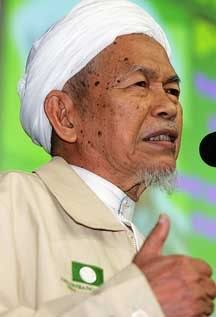
Where is Nasharuddin Mat Isa After His Meeting with Tok Guru Nik Aziz ?

Read here for more on "Jiwo Kelate" Blog

Related Article

  • PAS-Umno Unity Must Remain DEAD if PAS Is To LIVE

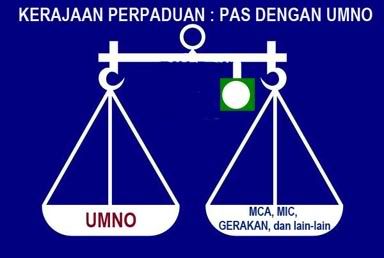
    The proposal to form a so-called unity government between PAS and Umno finally finds its rightful place — in a dustbin.

    If PAS-Umno unity comes true, PAS may break up as internal and external forces pull the political party in different directions.


    It is not every day one can expect Datuk Nik Aziz Nik Mat as the leader of PAS to tell off one of his prominent party members — Nasharuddin Mat Isa — to quit the party and join Umno after Nasharuddin spoke warmly of the possibility of PAS-Umno unity.

    The more liberal members of PAS, (or the Erdogans) have every incentive to NOT associate themselves with a pro-Umno PAS.

    Many of the Erdogans contested in areas where voters come from diverse backgrounds (and) they won on March 8, 2008 because they appealed to inclusive politics by convincing voters that PAS is for all and not just for the Muslims or the Malays, i.e. exclusive politics.

    Read here for more

Kenapa Timbalan Presiden PAS masih tidak hadir Parlimen?

Timbalan Presiden PAS, Nasharudin Mat Isa yang menjadi tumpuan di sebalik isu kerajaan perpaduan yang dilontarkan Presidennya, Datuk Seri Abdul Hadi Awang, masih belum muncul di Parlimen.

Nasharudin tidak hadir sidang Dewan Rakyat semalam dan hari ini. Malah, beliau juga tidak kelihatan di bangunan Khamis lalu.

Nasharudin hanya menghadiri pertemuan pemimpin kanan PAS dengan Murysidul Am PAS, Datuk Nik Abdul Aziz Nik Mat di ibu negara petang semalam. Bagaimanapun beliau tidak hadir mesyuarat khas Jawatankuasa Pusat PAS yang dipengerusikan oleh Hadi malam tadi.

Usaha menghubungi beliau menerusi panggilan telefon dan SMS juga tidak menemui hasil.
Read here for more

  1. Adakah Ini Sebabnya
    TINJAUAN PENDAPAT DALAM " The Edge":
    Nasharuddin sepatutnya...

    - Keluar PAS dan sertai Umno: 424 undi (44.4 peratus)

    - Memohon maaf dan melupakan rundingan perpaduan: 287 undi (30 peratus)

    - Berjumpa (Tok Guru) Nik Aziz untuk berbincang: 157 undi (16.5 peratus)

    - Terus merempit dengan rundingan perpaduan: 86 undi (9 peratus)


    Jumlah undi: 954
    Undian pertama: Friday, 19 June 2009 19:25
    Undian terakhir: Tuesday, 23 June 2009 15:31

  2. Atau Ini Sebabnya,

    Post mortem perlu dilakukan segera untuk mengenalpasti punca kepada masalah yang berbangkit. demi keutuhan parti dan menghapuskan semua "tohmahan" soalan2 berikut perlu dijawab:

    1. Inisiatif siapa?

    2. Pihak terlibat?

    3. Urutan kejadian?

    4. Adakah melibatkan orang tengah?

    5. Jika ada, siapa?

    6. Kenapa tidak dibincang di peringkat parti?

    7. Apakah terlibat 'pembelian' individu?

    8. Kenapa tidak terlintas kemungkinan perangkap?

    9. Siapa yang didorong dan oleh apa?

    10. Sejauh mana Cik Gu Pa terlibat/apa peranan dia?

    11. Sejauh mana Nasha terlibat/apa peranan dia?

    12. Sejauhmana TGHH terlibat/apa peranan dia?

    13. Haron Din, apa peranan dia?

    14. Harun Taib, apa peranan dia?

    Pakar2 bedah perlu cari apa yang patut dan parti mesti sediakan kertas putih bagi memulihkan kepercayaan dan sokongan ahli/penyokong terhadap parti. Hanya dengan 'pembersihan' sahaja kredibiliti PAS dapat dipulihkan.

    Ini bukan masalah rumah tangga, ayah dengan ibu bercerai, anak2 masih boleh bertemu dengan mereka. Masalah yang PAS hadapi lebih kritikal, ia melibatkan 'survival' parti.

    Untuk maju ke hadapan, punca masalah perlu di'kuarantinkan'.


  3. Atau Ini Puncanya .


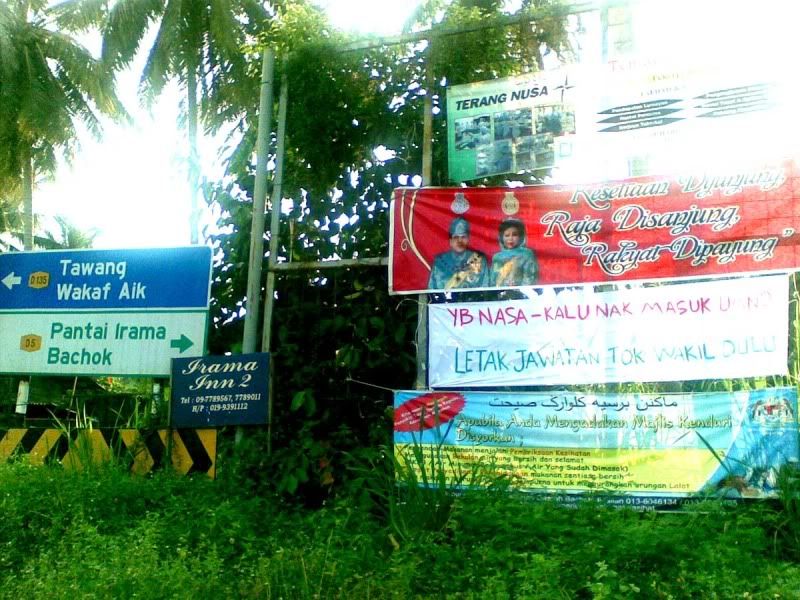
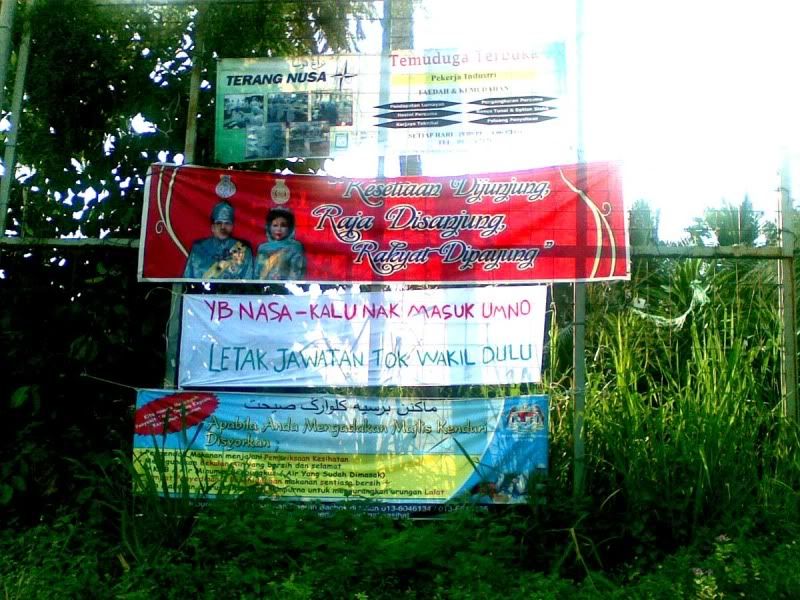
Di Cabang Tiga persimpangan ke Beris Kubur Besar


Simpang Tiga, Balai Polis Tawang menuju ke Pantai Senok
(Dekat Rumah YB Tawang Hasssan Mahmod)


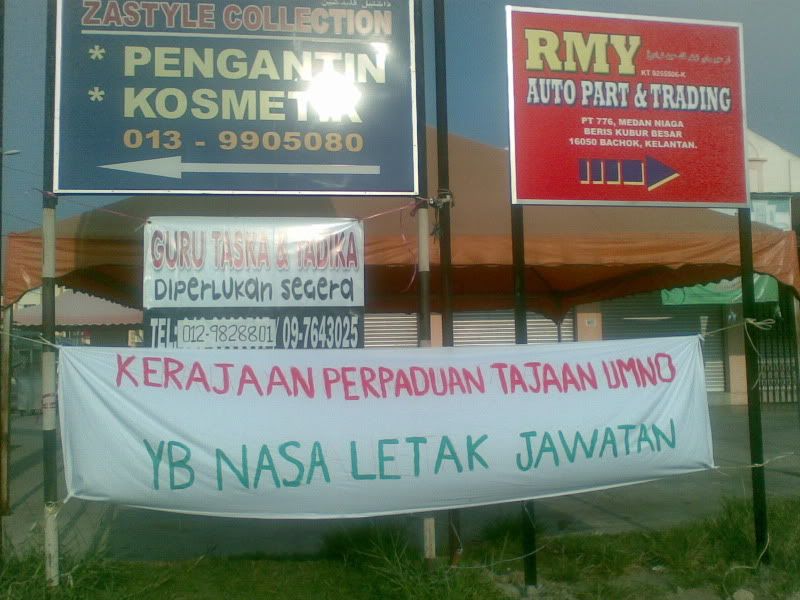
Simpang Empat, Beris Kubur Besar


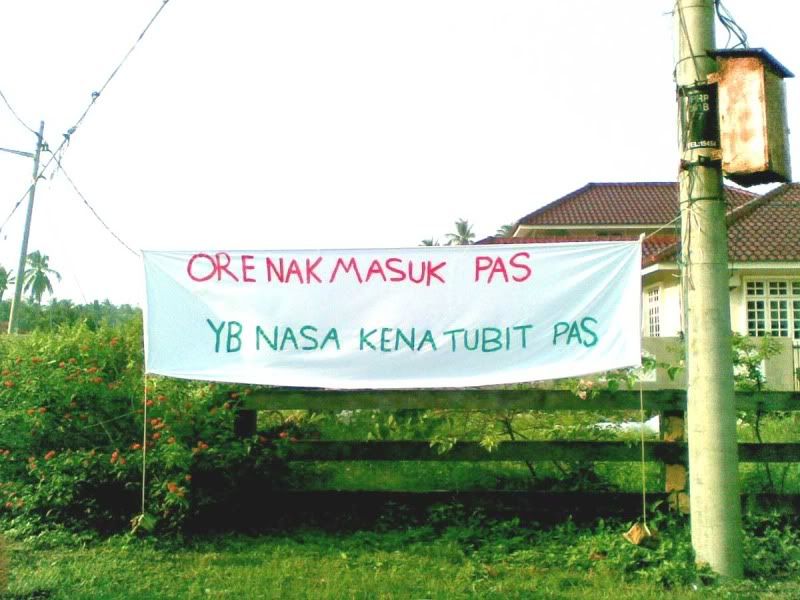
Simpang Tiga, Kg Kubang Kawah, Perupok
(Dekat rumah YB Ustaz Omar)


[Photos courtesy of Pinkturtle Blog]

Here is One Reason Why the English Language MUST be made Compulsory in ALL Malaysian Schools

Read here for more article in My Sinchew

With apologies to Mohsin Abdullah, for taking the liberty to transcribe his humorous and satirical piece below. It aptly paints a picture of the kind of standard we have of the English Language of our students today.
Now everyday I read the Inggeris papers to improve my Inggeris. Sorry. English.

I also say sorry to you all because my English not so good. Broken. But when my school time, they all say we must speak and learn with the Malay language. Easy lah for me. My mother tongue what.

Now everybody say Inggeris very important. Alamak always like that. English not the Inggeris. Sorry again.


I read the paper now, the very the many people say why English is very the important one, English also can help breach or bridge (so confuse. Susah lah this English language) international barrier. Got the people who say even China banking on English.

But now only they know that kah? Now only we know it is important? Last time when ask us to do all in Melayu language why never say? But never mind.

Now government want to make correct. Now maybe SPM also must pass English. I support the government. That why I agrees with the Pemuda UMNO who say retired teacher who good in English must take back.

Also teacher from Britain, England, New Zealand and Australia, (I always confuse with Austria. Mat Salleh country also make confuse). Brings them here to teaching our school childrens.


I supports but must slow slow also. If do now, fast fast student mati. Cikgu also trouble. Many teacher also cannot speak the English also. So I think maybe can start with standard one students next year. Tahun satu.

Then when they go year two can speak English already. So to makes them must pass the English in SPM ok. Fair what. They got time already. Maybe start from the kindergarten is also good.


For the rest student what to do. Like me lah. Just try the best to learns the English. Read the English paper everyday. Read the Star, the Sun, the NST. Got one more. The Malay Mail (again I confuse, mail and male).

Anyway we must talk talk in the English with the people when we go walk walk, eat eat in town. Don't shy shy one. People laughing never mind.


But I also wants to laughing when I read one news in the newspaper. I read the Star.I write again what I read in the Star baru baru ini.

It is like this. I copy straight from the Star paper.

"In Muar, Johor Menteri Besar Datuk Abdul Ghani Othman said the state government supported the call for English to be made a compulsory pass subject for the SPM.

He said although the state had protested against the teaching of Science and Mathmatics in English, the subject was important for Malaysians to master."

So if the Inggeris, sorry, English subject is important for Malaysians to master, why protest? That why I laughing.
Note: The writer, MOHSIN ABDULLAH , is Editor-in-chief, News and Current Affairs, ntv7 & 8TV. He says he started schooling in 1962 in an English medium school. For that, he thanked his parents for the opportunity and he thanked also the authorities for allowing English medium schools to continue to exist then.

Tuesday, 23 June 2009

PAS: A Political Party Yet to Come to Terms with Itself and Post-March 2008 Politics of Malaysia

WHICH IS THE REAL PAS ?


OR


Quote

The bottom line for PAS is this:
  • Is it an Islamic party trying to create an Islamic state?

  • Or is it a party that stands for Islam AND Malay nationalism?
This question has yet to be answered in a conclusive way.

IF PAS is for the establishment of an Islamic state, then it will have problems with DAP and all the non-Malay BN parties.

If it is for Islam AND Malay Race , then how is it DIFFERENT from Umno?


The recent PAS congress saw this ambiguity rise to the surface when the PAS Youth wing passed a resolution calling on PAS to retain the 30 per cent cap for Bumiputera businessmen.The “30 per cent” catchphrase is synonymous with Umno.

Hence what is the DIFFERENCE between PAS and UMNO?

The difference may be in the way the delegates dress but in substance, there may not be much of a difference.

The big problem for PAS in Malaysia is that, unlike other Islamic countries in the world, the constitutional definition of a Malay includes religion, Islam.

Thus PAS cannot separate race from religion unlike the situation in Indonesia or Iran.

Until PAS resolves this problem of the Malay race being equated with Islam, it will have to walk along the SAME road as UMNO.

The only question is whether it wants to travel in the same car or different car...."
-James Chin


Read here article "Quo vadis Pas ?" by James Chin on Malaysian Insider

Quo Vadis PAS ?

by

James Chin

Excerpts:

PAS is an interesting political creature.

It was started by a group of Umno members who were unhappy with Umno's “secular” outlook and early on wanted an Islamic model for Malaya, and later Malaysia.

Pre-March 2008 Election

In the early years, PAS was closeted in the Malay belt of Kedah, Terengganu, Kelantan and Perlis. Kelantan and Terengganu were always its stronghold. It could not break out electorally into the other states.

In 1973, it was caught up in Tun Razak’s new unity government called Barisan Nasional (BN) and joined.

Three years later, in 1977, it was booted out of BN for undermining the BN in Kelantan after PAS was split into a pro-Umno and anti-Umno faction. Since then it has been an opposition party.

Until the early 1990s, PAS was still very much closeted in the Malay belt. Although it was part of the Gagasan Raykat led by Tengku Razaleigh Hamzah in 1990, it was still unable to break out of the Malay heartland.

Its mantra of an Islamic state was deemed unacceptable to the Chinese community and DAP paid a heavy price for “sleeping” with PAS via Semangat 46 in 1990. Who can forget the infamous MCA slogan “a vote for DAP is a vote for PAS and Islamic state”?

" PAS for ALL" Slogan

Hence the recent PAS inroads into the non-Malay community is remarkable.

PAS's clever public relations — the slogan “PAS for All” — was a masterstroke. The term “Islamic state” was put in small letters and PAS leaders began to talk about issues dear to all Malaysians — justice, poverty, end of racial discrimination, etc.

No doubt the electorate was happy to accept PAS since many of the non-Malays were caught up with ABU — Anyone But Umno.

Using the “PAS for All” slogan finally allowed the party to escape the Malay belt. Now the party had national aspirations.

PAS's Dilemma

The problem was now it has to face PKR, in addition to Umno, for votes. PKR is not so much a problem as Umno.

The bottomline for PAS is this:
Is PAS an Islamic party trying to create an Islamic state? IF PAS is for the establishment of an Islamic state, then it will have problems with DAP and all the non-Malay BN parties

Or is PAS that stands for Islam and Malay nationalism? If it is for Malay race and Islam, then how is it different from Umno?
This question has been with PAS since Day One and it has yet to be answered in a conclusive way.

The recent PAS congress saw this ambiguity rise to the surface.

PAS, Malay Nationalism and and the Faction for Malay-Unity with UMNO Controversy

The PAS Youth wing passed a resolution calling on the party to retain the 30 per cent cap for Bumiputera businessmen.

As we all know, the “30 per cent” catchphrase is synonymous with Umno.

Since Islam does not condone racism and all Muslims are equal, you really have to ask if the PAS Youth call is against the true spirit of Islam since in practice it is racial/religious discrimination. The call is in line with Malay nationalism but not an Islamic state. (I wonder what the PAS Supporters Club has to say about this resolution?)

The call for “unity” talks by one faction in PAS is also a manifestation of this ambiguity.

Let us be frank. The “unity” talks are all about Malay unity and will lead to an all-Malay/Muslim government, if successful.

Hence what is the difference between PAS and Umno?

The difference may be in the way the delegates dress. But in substance, there may not be much of a difference.

PAS Youth Unable to Separate "Malay" from "Islam"

Many in the PAS Youth are graduates in Islamic studies (courtesy of the BN’s government in setting up Islamic studies courses in almost all public universities) from local universities and they cannot escape the notion of equating being Malay with Islam.

The big problem for PAS in Malaysia is that, unlike other Islamic countries in the world, the constitutional definition of a Malay includes religion, Islam.

Thus PAS cannot separate race from religion unlike the situation in Indonesia or Iran. If PAS were based in Indonesia, I’m sure none of the delegates will talk about the 30 per cent.

Until PAS resolves this problem of the Malay race being equated with Islam, it will have to walk along the same road as Umno. The only question is whether it wants to travel in the same car or different car.

Those who wish to know about PAS and its early days are recommended the following:
John N. Funston, “Malay politics in Malaysia: a study of the United Malays National Organisation and Party Islam”, Kuala Lumpur : Heinemann Educational Books (Asia), 1980.

Farish A. Noor, “Islam embedded: the historical development of the Pan-Malaysian Islamic Party, PAS: 1951-2003”, Kuala Lumpur : Malaysian Sociological Research Institute, 2004.

Perak Crisis:The Federal Court Judges Breached "Judges Code of Ethics". They Should be REMOVED under Section 2(2),Says Retired Court of Appeal Judge

Read HERE for more article by retired judge NH Chan

Quote:
"... As usual the Federal Court has missed the point again.

Since the people has been apprised of the law it would be foolish for any judge to give a judgment which is nothing but hogwash .

I
t was crassly insensitive of the judges to try to pull the wool over the eyes of the knowing public. But to our surprise, this is exactly what Nik Hashim FCJ did.

Recently, we discovered it was Augustine Paul FCJ who has this propensity. Now it is Nik Hashim FCJ who has the same propensity.

Now that WE, THE ORDINARY PEOPLE , know the law, WE could very easily judge the competence of these judges of the Federal Court."

By not administering justice according to law is this Federal Court’s besetting sin.

The judges of this court have, therefore, breached section 3(1)(d) of the Judges’ Code of Ethics 1994 for bringing the Judiciary into disrepute or to bring discredit to it, which is a ground for their removal from office by virtue of section 2(2) of the Code of Ethics..."

-N.H. Chan
Court of Appeal Judge (Retired)
Related Articles:

We Say

These five so-called pre-eminent judges succumbed to UMNO's partisan politics at the expense of justice demanded by Malaysians.

They have lost their credibility and trustworthiness as Judges in the highest court of our nation.

They have consistently failed in keeping the sacred trust of Malaysians to protect their constitutional rights, except perhaps for those whose sympathy lie exclusively with UMNO and Barisan Nasional.

They are:
  1. Alauddin Mohd Sheriff.

  2. Arifin Zakaria,

  3. Nik Hashim Nik Abdul Rahman,

  4. S Augustine Paul and

  5. James Foong.
-Malaysian Unplug

The Regurgitation of NOT Administering Justice According to Law in Written Judgment of Justice Nik Hashim in Jamaluddin & Ors v Sivakumar

by

N.H. Chan

EXCERPTS

In April 10, 2009, the New Straits Times reported:
The Federal Court has declared that three assemblymen who quit their parties are still members of the Perak state legislature.

This follows an unanimous ruling by a five-men bench yesterday which ruled that the Election Commission had the authority to declare a seat vacant. “The Election Commission is the rightful entity to establish if there was a casual vacancy in the Perak state legislature,” said Federal Court judge Tan Sri Alauddin Mohd Sheriff.

Sitting with him were Datuk Arifin Zakaria, Datuk Nik Hashim Nik Abdul Rahman, Datuk Seri S Augustine Paul and Datuk James Foong.
Following this newspaper report, I wrote an article titled “When Justice is not administered according to law”.

This is what I said:
Was the Federal Court right?

Before you can judge the judges of the highest court in the country, it is necessary for me to apprise you of the law applicable to the question which is the Constitution of Perak. I then pointed out that the law which is applicable is Article 31, Clause (5) of the Perak Constitution which reads:
" XXXI. (5) A person who resigns his membership of the Legislative Assembly of this State or any other State shall, for a period of five years beginning with the date on which his resignation takes effect, be disqualified from being a member of the Legislative Assembly of this State."
By this provision, Article 31(5), I pointed out that an assemblyman who resigns his membership of the Legislative Assembly is disqualified from being a member of the Assembly for a period of FIVE years from the date of his resignation.

I also showed that Article 33(1) says:
"XXXIII. (1) If any question arises whether a member of the Legislative Assembly has become disqualified for membership, the decision of the Assembly shall be taken and shall be final."
Article 33(1) means that when a question arises whether a person is disqualified from being a member of the Assembly, the decision (meaning “the vote”) of the Assembly is final.

Article 35 stipulates that an assemblyman can resign by simply writing to the Speaker:
"XXXV. A member of the Legislative Assembly may resign his membership by writing under his hand addressed to the Speaker."
I concluded with this observation:
The above is simple enough for all of us to understand. But then, all of us are wondering how on earth the Federal Court could have decided that the “(t)he Election Commission is the rightful entity to establish if there was a casual vacancy in the Perak state legislature”?

Don’t you all feel superior to the judges of the Federal Court because you know the correct answer whilst the highest court gave a wrong decision.

So you see, when you know how to judge the judges you would be able to separate the wheat from the chaff among our judges. The chaff, you will discover, may not be up to your expectations.
The Regurgitation in the Judgment of Nik Hashim FCJ

The dictionary meaning of “regurgitate” is “repeat information WITHOUT understanding it”.

Almost everyone knows the relevant law applicable, which is that:
It is the ASSEMBLY who decides the question of the disqualification of a member of the Assembly and not the Election Commission. It is only when a member has been disqualified would there be a vacancy in the Assembly.
Now that WE, THE ORDINARY PEOPLE , know the law, WE could very easily judge the competence of these judges of the Federal Court.

On June 8, 2009 (these judges) have handed down a written judgment as the judgment of the (Federal) court. delivered by Nik Hashim bin Nik Abd Rahman FCJ.

The judgment appears to be oblivious of the fact that the general public is now aware of the law applicable.

Since the people has been apprised of the law it would be foolish for any judge to give a judgment which is nothing but hogwash - it was crassly insensitive of the judges to try to pull the wool over the eyes of the knowing public.

But to our surprise, this is exactly what Nik Hashim FCJ did. As usual the Federal Court has missed the point again. Recently, we discovered it was Augustine Paul FCJ who has this propensity.

Now it is Nik Hashim FCJ who has the same propensity. He said:
The issue relating to question No. (1) is whether it is the Election Commission or the Speaker who has the right to establish if there is a casual vacancy of the State Legislative Assembly seats.

To answer the question, we have to consider the provisions of Article 36(5) of the Perak Constitution and section 12(3) of the Elections Act 1958, and the meaning of the words “casual vacancy” and the word “establish”.

Article 36(5) of the Perak Constitution states: “A casual vacancy shall be filled within sixty days from the date on which it is established by the Election Commission that there is a vacancy.”

Section 12(3) of the Elections Act 1958 reads: “In relation to a vacancy which is to be filled at a by-election, a writ shall be issued not earlier than four days and not later than ten days from the date on which it is established by the Election Commission that there is a vacancy.”

A “casual vacancy” is defined in Article 160(2) of the Federal Constitution to mean - “a vacancy arising in the House of Representatives or a Legislative Assembly otherwise than by a dissolution of Parliament or of the Assembly.”

The word “establish” is defined in the Oxford Advanced Learner’s Dictionary, 6th Edition to mean: “to discover or prove the facts of the situation; ascertain.” And the Shorter Oxford English Dictionary defines the word “establish” to mean: “to place beyond dispute; to prove.”

In construing the Perak Constitution, the provisions of the other State Constitutions and the Federal Constitution need to be considered. By comparison, the State Constitutions of Kelantan (Article 46(5)), Malacca (Article 19(5)), Pahang (Article 26(5)), Penang (Article 19(5)), Perlis (Article 55(5)), Sarawak (Article 21(5)), and Kedah (Article 53(5)) contain provisions similar to Article 36(5) of the Perak Constitution which states that “A casual vacancy shall be filled within sixty days from the date on which it is established by the Election Commission that there is a vacancy”, whereas the Constitutions of the State of Johor (Article 23(5)), Negeri Sembilan (Article 56(5)), Selangor (Article 70(5)) and Terengganu (Article 44(5)) provide that “A casual vacancy shall be filled within sixty days from the date on which it occurs.”
The verbiage continues from page 11 to page 18 of his 20-page judgment where he concluded, thus:
".. Hence we unanimously ruled that the decision of the respondent Speaker declaring the three State seats of N.59 Behrang, N.14 Changkat Jering and N.31 Jelapang vacant was unlawful and therefore null and void as the decision was contrary to Article 36(5) of the Perak Constitution.

Accordingly, our answer to question No. (1) is in the affirmative. Having answered the question we found that there is no necessity to answer question No. (2)..."
Now that you know the law which is applicable, you are in a position to judge the five judges.

What do you think of the quality of these judges of the highest court in the country?

You must think that after all the rigmarole and after all the effort in writing this 20-page judgment, they could have done better.

But NO , they still missed the point altogether.

All of us ordinary folk knew the answer. But not these FIVE judges.

  1. The point is: Article 33(1) of the Perak Constitution which says that when a question arises whether a person is disqualified from being a member of the Assembly, the decision (meaning “the vote”) of the Assembly is FINAL. It is NOT the Speaker nor the ELECTION COMMISSIONER who determines if a person is disqualified from being a member of the Assembly.

  2. If a person resigns his membership of the Legislative Assembly, he shall be disqualified from being a member of the Assembly for five years from the date of his resignation: see Article 31(5). Article 35 only says that a member can resign simply by writing to the Speaker.

  3. So that if any question arises as to the resignation of the three turncoat Assemblymen - a person who resigns his membership of the Assembly is disqualified for five years from being a member of the Legislative Assembly - the decision of the Assembly by a vote being taken on their disqualification shall be FINAL.

  4. It is only after a member of the Assembly has been disqualified for membership of the Legislative Assembly that a vacancy of the member’s seat in the Assembly arises. It is only then that a casual vacancy arises. And by Article 36(5):
    XXXVI. (5) A casual vacancy shall be filled within sixty days from the date on which it is established by the Election Commission that there is a vacancy.
In my (earlier) article I wrote, I had pointed out the misreading of Article 36(5) by the highest court in the land:
".. A casual vacancy means an occasional vacancy which can be filled simply with a by-election.

But the question whether the turncoat assemblymen have resigned or not will have to await the outcome of the decision of the Assembly which decision shall be final: see Article XXXIII, Clause (1).

It is only upon receiving the decision of the Legislative Assembly will the Election Commission be able to establish that there is a vacancy.

As it turns out the Federal Court have put the cart before the horse - in this case, just the cart without the horse - which is that the court has held that it is for the Commission to establish that there is a casual vacancy without waiting for the decision of the Assembly whether the three turncoat assemblymen have been disqualified for membership of the Assembly by resignation.
By not administering justice according to law is this Federal Court’s besetting sin.

The judges of this court have, therefore, breached seciton 3(1)(d) of the Judges’ Code of Ethics 1994 for bringing the Judiciary into disrepute or to bring discredit to it, which is a ground for THEIR REMOVAL FROM OFFICE by virtue of section 2(2) of the Code of Ethics.

Tok Guru Nik Aziz and Nasharuddin Mat Isa Made Peace on Unity-Govt Issue

Read here for more

Datuk Nik Aziz Nik Mat has made peace with PAS deputy president Nasharuddin Mat Isa over the issue of unity government with UMNO.

Nik Aziz had a closed door meeting with Nasharuddin at the PAS headquarters here and issued a statement that they have sorted out their differences and agree not to raise the unity talk issue anymore.

“We have decided, in a family spirit, to settle our differences over the issue which has been exploited by the mainstream media,”
Nik Aziz said in the statement.

Nasharuddin has been the target of Nik Aziz’s attack for his pro-unity talks stand and the rift between the two culminated with the latter’s outburst, calling for the former to resign and join Umno after he stubbornly floated with the unity government idea despite heavy protest.

Today Nik Aziz retracted his past statements made against Nasharuddin, who is also Bachok MP.“So this issue between me and him should no longer be raised,” Nik Aziz said further.

His comments echo the earlier joint statement to reject any form of unity talks with Umno, which was made by Pakatan Rakyat leaders in Parliament this evening. That statement was meant to end the fiasco which brought the opposition coalition to the brink of separation.

Pakatan leaders, including unity government proponent, PAS president Datuk Seri Abdul Awang, also made fresh loyalty pledges to strengthen the electoral pact and prepare for a possible takeover of the federal government in the next general elections.

Monday, 22 June 2009

Hadi Awang Makes U-Turn on Unity-Talks with UMNO After Meeting of Pakatan Leaders

Read here for more and here


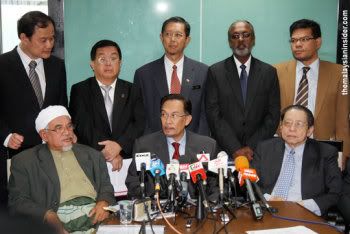
Pakatan Leaders Meeting -June 22, 2009 at Parliament House
(Photo courtesy of Malaysian Insider)

PAS President Hadi Awang made a drastic turnabout, saying the unity government idea was ill-conceived – even by Umno themselves – and that PAS was only willing to “engage” Umno/BN on specific issues and not on Malay and Islamic unity as reported in the past after a meeting of Pakatan leaders today in Parliament House (June 22) .

He also assured that differences between party spiritual leader Nik Abdul Aziz Nik Mat and deputy president Nasharuddin Mat Isa "will be resolved tonight."

PAS will hold its central committee meeting tonight where this matter, including the unity talks with Umno, are expected to be the main agenda. Previously, Nik Aziz told Nasharuddin to quit PAS and join Umno in relation to the latter’s support for holding unity talks with Umno.

Following a meeting held in Parliament today, Pakatan Rakyat (PR) leaders today rejected Umno's unity government proposal, and proclaimed all issues surrounding the fiasco which brought the fledgling opposition coalition on the brink of collapse resolved.

In a joint statement, they reiterated their loyalty pledge to strengthen the alliance, wanting to focus instead on their preparation for the next general election and a potential takeover of the federal government. PR leaders said that PR is willing to engage Umno/BN on matters such as improving the quality of education, restoring the integrity of the judiciary and eradication of corruption.

PKR de facto Datuk Seri Anwar Ibrahim at a press conference held after the meeting said,
"The PR council of leaders reaffirms our rejection of the idea of forming a unity government with Umno/Barisan Nasional.

It is a clearly malicious and desperate attempt to compromise the integrity of the increasingly popular PR."
Anwar held various private meetings with Hadi, DAP’s Lim Kit Siang and PAS spiritual leader Datuk Nik Aziz Nik Mat in the past week, playing mediator by urging them to bypass the unity talks controversy and move on.

Besides the three main leaders, others present at the meeting were PKR president Dr Wan Azizah Wan Ismail, her deputy Syed Husin Ali, vice-presidents Azmin Ali and R Sivarasa. Others include DAP secretary-general Lim Guan Eng, DAP Cheras MP Tan Kok Wai, PAS secretary-general Mustafa Ali, vice-president Mahfuz Omar and central committee member and Bukit Gantang MP Mohammad Nizar Jamaluddin.

MUST READ ARTICLE! The POISON of “UNITY ” Government

Read here for more on M.Bakri Musa blog


Quote

This “unity government” scheme is nothing more than a crude and greedy power-grab by the UMNO and PAS pair.

This latest scheme is the ugliest manifestation of Malay ultra chauvinism.


It would lead not to unity but greater polarizations among Malays as well as between Malays and non-Malays, and at a time when we can least afford it. The initiative would poison race relations in the country on a scale comparable to the May 1969 tragedy.

The proponents for this “unity government” have obviously not done their due diligence or any downstream analysis. Those UMNO warlords would not take kindly to sharing their bounty with their new kopiah-clad upstart colleagues.

Far from ‘purifying’ UMNO, PAS would end up being just as corrupt as UMNO.


Instead of wasting time and effort in chasing the mirage of Malay ‘unity’ and in the process unnecessarily alienating others, Malay leaders should focus on the more difficult and critical problem of enhancing Malay competitiveness. This problem CANNOT be solved simply by shouting slogans of "Malay Unity" or Ketuanan Melayu.


Malay leaders should not be deluding the masses with half-baked ideas of “Malay unity.” These leaders succeed only in deluding themselves.

-Dr. M. Bakri Musa

Bernama reported:
Mukhriz Mahathir said today it would be difficult to realise the 1Malaysia concept IF the Malays are NOT united. He said the Malays played an important role in ensuring the country's progress as they are the MAJORITY in the country
.
Read HERE for more

The Poison of “Unity” Government

by

M.Bakri Musa

Read here for more

The two Malay political parties – UMNO and PAS – are battling each other to convince us that each is better than the other in advancing the “Malay agenda.

The two are like ageing fighters stuck with their same old tired moves. They are oblivious of the fact that we are fed up with their act; their lack of vigor and imaginative new strategies.

In a clumsy if not desperate attempt for new moves they concocted a ‘vision’ for a ‘unity’ government based on the two parties! Left unstated is the question: Unity for what and against whom?

I wish that they would expend their efforts on making our people competitive, and thus lifting us out of poverty. That is the most important Malay agenda today. Better yet, I would prefer that they just exit the ring and let others run the show for a change.

I fail to see how this ‘unity’ government would make Malays more competitive.

The track record for UMNO is for all to see. Corruption is now rampant, as well as the erosion of the integrity of our institutions and the deepening polarization of Malaysians.

The Melayu Baru (New Malay) of UMNO has now morphed into Melayu Barua (Malay scoundrels).

As for PAS, after decades of ruling Kelantan, the young still has to leave the state to seek a better life. The state is regularly plagued with such diseases as cholera.

Tok Guru Nik Aziz may be pious and religious, with honesty and humility thrown in massive doses, but he is completely inept in running a modern state. Apparently his humility does not extend to his intellect for he has not seen fit to seek competent help in such ‘secular’ matters.

New Political Reality

UMNO and PAS are so used to fighting each other that they have forgotten what it is they are fighting for. While they are busy fighting each other, the world has passed them by.

Today with the increasing plurality of the Malaysian electorate, securing the majority Malay votes would not necessary translate into political power, at least at the national level.

In a rare display of political wisdom, PAS recognized the need to reach beyond by, for example, fielding non-Malay candidates in the last election and establishing a new wing within the party for non-Muslims. However, whatever inroads the party may have made with non-Malays have since evaporated with its ill-conceived pursuit of a “unity government” with UMNO.

UMNO, a slow learner, has yet to recognize this new political reality. Thus it treats its non-Malay coalition partners in Barisan with undisguised contempt. UMNO leaders are quick to brandish their kerises, preferably dripped with ketchup for dramatic effect, at the slightest provocation.

Chauvinistic appeals of Ketuanan Melayu to win Malay votes might still work, but only regionally in Kedah, Perlis, Kelantan, and Trengganu. Unfortunately those are not exactly the economic or power centers of the nation.

In terms of population, landmass, and most importantly economic activities, the contributions of those states to the national total are at best miniscule.

The elements overrepresented in those states are poverty and the underdevelopment of the people, and the overwhelming majority of whom are, sadly, Malays. Oh, yes, combined those four states have nearly half (four out of nine) of the sultans. For some, that is a source of endless pride.

As for the much-vaunted Malay agenda or even Ketuanan Melayu, I am at a loss as to what exactly these Malay politicians are fighting for.

If it is for retaining the Malay language, sultans and other key elements of Malay culture, including and especially Islam, those are already enshrined in our constitution. Even if non-Malays were to oppose that, there is not much that they could do about it. By themselves they could never secure the necessary two-third majority needed to amend the constitution.

The only way for non-Malays, or anyone else for that matter, to do away with those constitutional provisions would be to bribe Members of Parliament (Malays and non-Malays) to amend the constitution. Then just to be sure, also bribe the Senators and also the King and sultans so they too would agree with the changes.

The price tag would be cheap. The late Tun Ghaffar once suggested that for a few hundred million ringgit you could buy the entire UMNO Supreme Council. With a billion or two you could get the whole parliament and the Council of Rulers.

The colonial British secured the entire country for considerably much less, even after factoring in for inflation and devaluation (of both the sterling and ringgit). Flattery made up for what they could not afford in gold. The British offered fancy titles like the Knighthood of some Medieval Order to our leaders and sultans to win them over.

The corollary to my observation is that if we Malays truly wish to preserve our cherished special privileges, we better start electing honest and incorrupt leaders. Corrupt leaders would not only sell off those special privileges, they will also sell away our country.

Unity for What and Against Whom?

Following the Barisan election rout of March 8, 2008, the fear that the coalition, specifically UMNO, would lose power at the national level was palpable. This desperation led misguided souls in UMNO to seek those in PAS who had been longing for power. This quest for a ‘unity government’ was nothing more than UMNO securing an insurance policy for its continuing hold on power; for PAS, it was a seductive teasing on the taste of power.

It is ironic that the pursuit of a “unity government” resulted only in sowing distrust within the existing coalitions. In pursuing PAS, UMNO succeeded only in straining relations with its long-time Barisan partners.

PAS meanwhile managed only to poison its still frail Pakatan Rakyat coalition with PKR and DAP. Worse, as we are now seeing, it also threatens the unity of PAS.

The proponents for this “unity government” have obviously not done their due diligence or any downstream analysis.

Those UMNO warlords would not take kindly to sharing their bounty with their new kopiah-clad upstart colleagues. Far from ‘purifying’ UMNO, PAS would end up being just as corrupt as UMNO.

It is remarkable that both Tun Mahathir and Tok Guru Nik Aziz are against the idea. I do not know their individual motives, but the fact they are both in rare agreement should serve as a cautionary note.

If the disintegration of UMNO and PAS were the consequence of this “unity” movement, I could not care less. However, the initiative would poison race relations in the country on a scale comparable to the May 1969 tragedy. Indeed the venom has already seeped out. That should concern everyone.

This “unity government” scheme is nothing more than a crude and greedy power-grab by the UMNO and PAS pair.

It is not to be confused with Tun Razak’s version following the May 1969 tragedy. Then it was truly a unity initiative, with the wise Tun opening up the old Alliance coalition to all willing participants.

This latest scheme is the ugliest manifestation of Malay ultra chauvinism. It would lead not to unity but greater polarizations among Malays as well as between Malays and non-Malays, and at a time when we can least afford it.

Even if UMNO were to merge with PAS, the new coalition would still never command a two-third majority in Parliament. At last count, even if every Member of Parliament with a Malay-sounding name were to vote in “unity,” that would still fall far short of a supra majority needed to amend the constitution. The political calculus has changed irreversibly.

The central reality is that Malays will have to advance with and not at the expense of non-Malay Malaysians. Likewise, non-Malays would advance along with and not at the expense of Malays. The unity that we should all strive for must not only be among Malays but also among Malaysians.

We can begin that process not by pursuing a “unity government” but DECREASING the rhetoric that polarizes our society. Demanding that our political leaders be civil and courteous to each other would be an excellent beginning.

Oh yes, please also keep those kerises sheathed!

It amuses me that the most vigorous proponents of this “unity government” in UMNO and PAS are also the shrillest and most divisive voices before they discovered this ‘unity’ religion.

A New Direction For Malays

Instead of wasting time and effort in chasing the mirage of Malay ‘unity’ and in the process unnecessarily alienating others, Malay leaders should focus on the more difficult and critical problem of enhancing Malay competitiveness.

This problem cannot be solved simply by shouting slogans of Malay unity or Ketuanan Melayu. Instead we need leaders who are smart, competent, diligent, and above all, not corrupt.

Look at the schools Malay children attend. How can we expect them to learn English or science when we do not provide them with competent teachers? Examine the institutions run predominantly by Malays, the civil service for example.

As Malays we should be ASHAMED of this. We need these institutions to be effective as they are a key to making Malays COMPETITIVE.

The list is endless. What is limited, and severely so, is the willingness to acknowledge, let alone solve them. I have yet to hear something sensible from either PAS or UMNO leaders.

So far PAS wants Malays NOT to learn English and to ban Sisters in Islam. Well, that is an advancement of sorts; at least they are not harping on hudud. As for UMNO leaders, theyCANNOT even decide whether to continue teaching science and mathematics in English.

Malay leaders should not be deluding the masses with half-baked ideas of “Malay unity.” These leaders succeed only in deluding themselves.

Sunday, 21 June 2009

Tok Guru Nik Aziz Tells UMNO: Apologise for UMNO's Past Bad Behaviour Against PAS

Read here article in Malaysian Insider by Adib Zalkapli


Datuk Nik Abdul Aziz Nik Mat today demanded Umno apologise for their past actions against PAS.

He also reiterated his stand that engagement with Umno is NOT necessary, saying that it would be difficult for PAS to strengthen Pakatan Rakyat (PR) and to work with the Malay nationalist party at the same time.

UMNO Must Apologise

The Islamist party spiritual advisor was responding to Tan Sri Muhyiddin Yassin's remark on Friday where the deputy prime minister urged PAS to let bygones be bygones and work towards forming a unity government.

"They want me to forgive, they must first admit their mistakes and apologise," Nik Aziz told reporters at his official residence here before meeting Datuk Seri Anwar Ibrahim.

Opposition to Unity Talks Consistent With Muktamar's Policy

The Kelantan mentri besar added that his opposition to the unity government proposal is consistent with the decision of the PAS muktamar or general assembly last year.


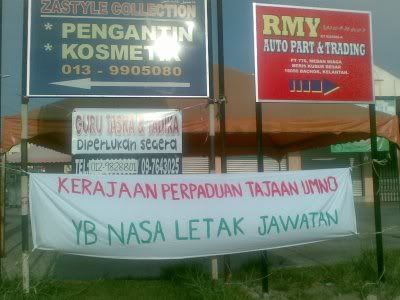
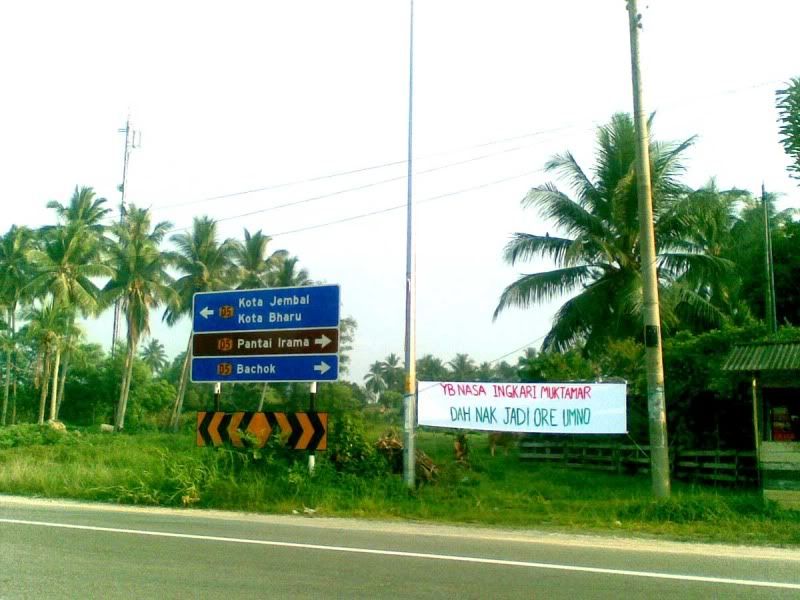
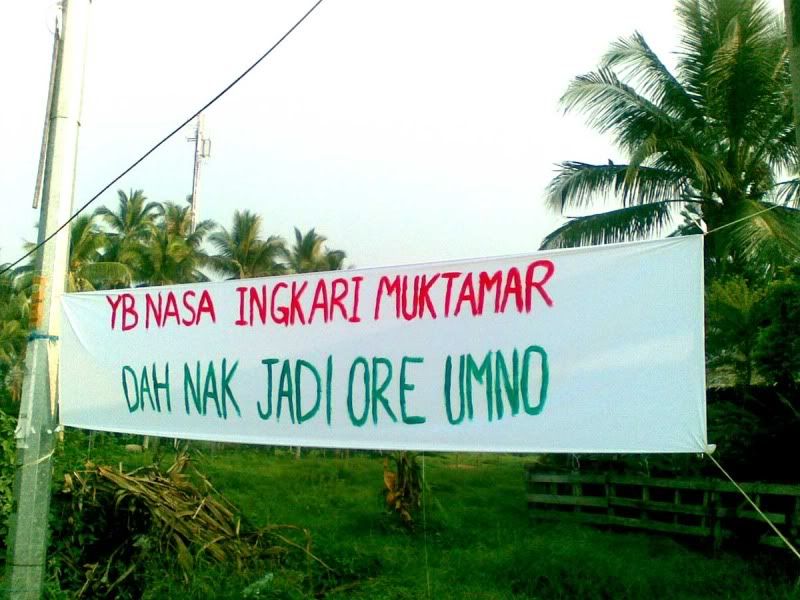
Banner put up in Nasharuddin's Bachok, Kelantan constituency
(Photo courtesy of Kickdefella blog)

"I am not being stubborn, I am just defending the decision of the muktamar. Proper procedure must be followed," said Nik Aziz.

During the party's muktamar early this month, both party president Datuk Seri Abdul Hadi Awang and his deputy Nasharudin Mat Isa promised to remain in PR but would continue talking to Umno on specific issues.

Nik Aziz has continued voicing out opposition to working with Umno and had even asked Nasharudin to leave the party and resign as Bachok MP for his stand on unity talks with their political rivals.

PAS is expected to put an end to the public disagreement through PR leadership meeting and the special central working committee meeting.

Nik Aziz has also called for meeting with Hadi, Nasharudin and leaders who are seen to be in favour of pursuing unity talk with Umno.

TWITTER: The New Networking that is Now Shaking the World (and Iran)

Read here for more on Guardian UK

Twitter: The tweet that shook the world

by

Bobbie Johnson

Politicians have been excited by the new way of connecting with the public, including Obama, whose staff used Twitter during last year's election, and a steady stream of MPs, congressmen, senators and other influential individuals.

When President Barack Obama wasn't concerned with swatting flies or wrestling with Congress last week, he had something else on his mind. Despite the political wildfire spreading in Iran, State Department officials were hamstrung by America's difficult relationship with Tehran: they wanted a way to influence events on the ground without getting involved in them. And so they turned to the internet.

Their unexpected source, though, was not Iran's vast army of political bloggers or even the web providers blocked by the country's censorious government. Instead, they went to American online messaging service Twitter, the social network that had swiftly become a central source of information with blow-by-blow updates about the post-election protests.

Hearing the news that engineers at the Californian company were planning to take the website offline to perform some maintenance, officials in Washington made what perhaps marks the oddest political phone call seen since Dr Strangelove.

Their message to Twitter? "Don't stop."

"It's humbling to think that our two-year old company could be playing such a globally meaningful role that state officials find their way toward highlighting our significance," said Biz Stone, one of the company's founders the next day.

The site undoubtedly played a vital role in spreading the story from inside Iran to the outside world, as thousands of web users and mobile phone addicts passed on messages and pictures documenting events on the ground.

It is easy to overestimate Twitter's value inside Iran, where word of mouth, phone calls and text messages were almost certainly more important in helping to organise rallies. But its influence in making the story global was very real.

All of this attention marked the latest high point in Twitter's dizzying ascent, a rapid rise that has seen its crew of geeks find themselves at the heart of geopolitics more by accident than design.

Three years ago, the company's founders were toiling away on a different internet project, an interesting but ultimately unpromising podcasting company called Odeo. Programmer Jack Dorsey showed his colleagues an idea for a simple website that let people update their activities and whereabouts by mobile phone. They liked it, built a prototype and Twitter was born.

Long before it became a high-powered political tool, however, it began simply as a way for geeks to tell each other what they were doing online.

It allows each user to send a short update on their current activity to a selected group of friends from a computer or mobile phone. Restrained by text message technology to a limit of just 140 characters, users answered the question: "What are you doing?" in as straightforward or creative a way as they chose.

What started off as a side project soon became the main event; the team switched from Odeo and the third co-founder, Evan Williams, used the proceeds from his previous business (Blogger.com, which he sold to Google in 2003 for several million dollars) to fund Twitter's early development. Then, it was known as Twttr, though that name, displaying the disemvowelled grammar that became a hallmark of trendy web companies in recent years, was swiftly ditched in favour of a more mainstream-friendly version.

Cheered on by adoring crowds in Silicon Valley, the site blossomed, turning into a sort of internet chat-room as millions of people swapped messages.

Importantly, it was boosted by the presence of celebrities: famous British faces like Stephen Fry, Jonathan Ross and Philip Schofield, as well as American names like Britney Spears, rapper 50 Cent and basketball star Shaquille O'Neal.

Because users choose whose messages they want to see on their Twitter home page, these famous names could actually interact with their fans - albeit in a limited way.

Unsurprisingly for a trio of archetypal San Francisco geeks, its creators have struggled with their newfound celebrity pull. "The level of attention has been surprising," said Williams, with typical understatement.

And yet they court it all the same: Oprah Winfrey invited a bashful Williams on to her show in April for a special segment dedicated to the service, while Stone looked slightly overwhelmed during an appearance on the popular spoof chatshow hosted by comedian Stephen Colbert.

"My guest tonight is the co-founder of Twitter - I'll ask him about every mundane moment of his life," quipped Colbert.

Except it is that mundanity, in part, that has helped push Twitter from a nerdy experiment to a genuine phenomenon: it is easy to use, but vast in its scope.

Plenty of detractors have gnashed their teeth along the way: they despise its addictive immediacy, the hype that has accompanied its rise or, more often, they complain that it improperly elevates the inner thoughts of those who trade in banalities and mindlessness. Some attack its inherent unreliability (though since they get to choose precisely whose messages to read, the question seems moot), while others decry its growing power online.

Worse still, then, that it has been embraced by the celebrities who often represent the worst strands of our vacuous and fame-seeking modern culture. But for every Britney Spears, Twitter has also shown the surprising ability to inhabit a geopolitical world.

Clay Shirky, a professor at New York University renowned for his analysis of the way people interact online, has described the attraction in glowing terms. "These tools don't get socially interesting until they get technologically boring," he said recently. "It isn't when the shiny new tools start permeating society, it's when everyone can take them for granted."

Indeed, its impact was so powerful that Shirky has since called Iran "the big one ... the first revolution that has been catapulted on to a global stage and transformed by social media".

With lives on the line at Tehran's anti-Ahmadinejad protests, few could mock the inanity of the system, but Iran is just the latest in a series of major events that have been given an extra global witnesses thanks to Twitter.

Early last year, the first reports of the earthquake in China's Sichuan province broke on Twitter, while the end of 2008 saw users document the Mumbai attacks for a global audience before the news networks had got on to the story. The first images of the US Airways craft that crash-landed in New York's Hudson River, meanwhile, prompted the BBC to call it "a classic of the new age of citizen journalism".

As a result, what started as an experiment between a handful of employees has now found itself reaching a strange crossroads where society, technology and politics interact with each other, sometimes with profound effects. And in doing so, Williams, Stone and Dorsey have become the latest in a parade of US technology geeks who have achieved some form of political influence without ever being actively political.

Their predecessors in this include Google's founders, for example, who espouse a "don't be evil" mantra despite the fact that their intentions remain vague and their philanthropy is often tightly linked to the business they started. Microsoft billionaire Bill Gates, meanwhile, has turned his sizable bank account to saving the world, but only after he had spent 20 rapacious years becoming one of the most powerful people in it.

The end result is that Twitter is riding a curve of hype that, for the time being, shows no sign of turning back against it. Celebrity allure, political power and technological smarts have all arrived at the same time.

That is all nothing compared to its reputation on its home turf, where, despite much-heralded internet startups being 10 a penny, Twitter is regarded largely with reverence. Everyone from Google to Apple has reportedly inquired about buying the company, and earlier this year Twitter rejected a $500m takeover bid from Facebook.

By anybody's standards, that is a high price to turn down, but in the face of an almost insatiable appetite from the public, the company's creators believe they have stumbled upon something that is worth substantially more: in prospecting for a way out of the doldrums of their previous business, Williams, Stone and Dorsey instead found gold.

"I've called it social alchemy," said Stone recently. "Take a tweet that you think is meaningless or valueless - like I'm grabbing a beer at the airport. It's of little value, but if somebody gets it in real time ... and they say, 'I'm in the airport and I'll meet Biz for a beer', we've turned that lead into gold."

The Twitter Lowdown

Born:
21 March 2006 - opened publicly in July of the same year.

Founders:
Jack Dorsey (4 April 1977), a programmer from St Louis, Missouri; Biz Stone (10 March 1974), social networking expert from Massachusetts; and Evan Williams (31 March 1972), serial entrepreneur from Nebraska.

Best of times:
Twitter has a recurring role in helping spread news of major events, but it was an appearance on Oprah Winfrey's popular US television show that took it to the masses. The host logged on to the site with a welcome of "HI TWITTERS" - immediately gaining more than 250,000 new fans and sparking a huge growth in the site's user base.

Worst of times:
The site was so unreliable for a period in 2008 that the so-called "fail whale" - a character who appears whenever the site is overloaded - became a cult figure with its own online fan club.

Others say: "It is a magnificent way of cutting out the press. I'm getting new tweets all the time and some of them are very amusing and some of them are rather silly, but most of them are entirely charming." Stephen Fry, one of Twitter's most popular and enthusiastic users

They say: "It distills a lot of what makes the internet exciting into a really simple form." Evan Williams in a TV interview.

She Is Only FOUR Years Old !

Put on your speakers !!

Her name is: Aimi Kobayashi (小林愛実 ).

She was FOUR years old (1999) when she played on stage this piece Clementi's Sonatina 36


She lived in Ube, Yamaguchi Prefecture, Japan until February 2007 and now in Tokyo, started studying piano at the age of 3, played with an orchestra at age 7, and has been receiving tutelage from Yuko Ninomiya since 8 years old, and has won the Yamaguchi Prefecture "Glory Culture Prize" three times.

Aimi Kobayashi's Profile

Born September 23rd, 1995.

Aimi has been playing the piano since she was 3 years old. Starting in 2001 Aimi won the world's largest Piano competition - The PTNA Piano Competition, 4 years in a row.

In 2004 aged 8 years old, Aimi made a new world record as the youngest winner of the National Sonare Award (Junior Level G).

At the 2003 Tosu City Hupfer Memorial Piano Concours for Peace, Aimi came first winning the children's Grand Prize. 2004 saw the 5th International Chopin Piano Competition in Asia, where Aimi won the Gold prize at 1st and 2nd grade Elementary School level. In 2005 Aimi Kobayashi became the first fourth-grader in the past 59 years to come first in the final round of the Student Music Councours of Japan, Elementary School Division (4th - 6th grade).


Aimi's debut recital at age 9

At age 7 Aimi played with an orchestra, and achieved her international debut at the age of 9. Until this point most of her concert appearances had been national solo or concerto performances such as with the Kyushu Symphony Orchestra, but in 2005 Aimi traveled to perform in Paris (Cortot Hall) and New York (Carnegie Hall, sponsored by AADGT).

Due to the Carnegie Hall appearance, Aimi was featured in a French television program that was broadcast to the whole of Europe.

Tokyo MX TV aired the program, and in December of the same year Aimi appeared on NHK Television.

In January 2006 Aimi performed in Tokyo Opera City Hall with the Yomiuri Nippon Symphony Orchestra.

The orchestra has a history of over 40 years but Aimi is quoted as being the "youngest soloist since the violinist Mayuko Kamio performed when she was still at Junior High School" (Ms. Egami, Yomiuri Nippon Symphony Orchestra, Performance division). The concert was featured by NTV Japan.

She has won the Yamaguchi Prefecture "Glory Culture Prize" 3 times. Aimi has been receiving tutelage from Yuko Ninomiya since she was 8 years old.

In October of 2006 Aimi performed in Carnegie Hall's Isaac Stern Auditorium as part of the "The Passion of Music" concert sponsored by AADGT.

In December 2006, AADGT sponsored Aimi's performance of Mozart's Piano Concerto No. 26 ("Coronation Concerto"), conducted by Vladimir Spivakov at the Moscow International House of Music. The concert was a great success, and was featured on Russian television.

Aimi played with the Tokyo Philharmonic Orchestra at Suntory Hall on March 31st, 2007.On April 2nd Aimi gave a Debut Recital at the Symphony Hall of Acros Fukuoka.

Aimi 's Achievements

# 2004 Won the Gold prize at 1st and 2nd grade Elementary School level in the 5th International Chopin Piano Competition in ASIA.

# 2005 Won the first prize in the elementary school division of the Student Music concours of Japan when she was in the fourth grade.

# 2005 Invited to play at Salle Cortot and Carnegie Hall.

# 2006 Performed at Tokyo Opera City Hall with the Yomiuri Nippon Symphony Orchestra in January.
# 2006 Performed at Carnegie Hall again on October 29.

# 2006 Performed Mozart's Piano Concerto No. 26 ("Coronation") with Vladimir Spivakov conducting the Moscow Chamber Orchestra and as an encore she played Chopin's 1st Impromptu at Svetlanov Hall (Moscow International House of Music) in Moscow on December 24.

# 2007 Played Beethoven's Piano Concerto No.1 with the Tokyo Philharmonic Orchestra at Suntory Hall on March 31.

# 2007 Gave a Debut Recital at the Symphony Hall of Acros Fukuoka on April 2.

# 2008 Recorded her first CD in New York, arranged by AADGT with the financial support by Global Private Equity.

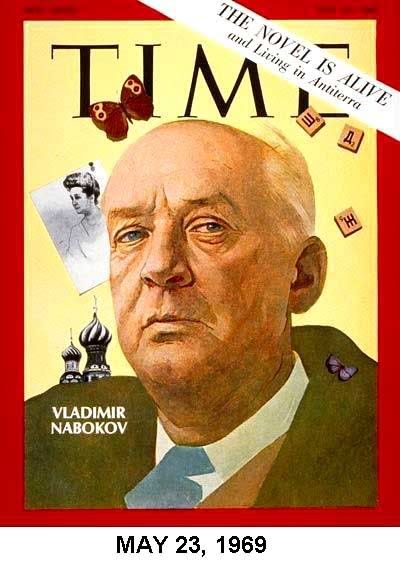
FLASHBACK from Time Magazine: 1969 - Malaysia's May 13 Racial Riots


The World

RACE WAR IN MALAYSIA
Friday, May. 23, 1969


MALAYSIA'S proud experiment in constructing a multiracial society exploded in the streets of Kuala Lumpur last week. Malay mobs, wearing white headbands signifying an alliance with death, and brandishing swords and daggers, surged into Chinese areas in the capital, burning, looting and killing.

In retaliation, Chinese, sometimes aided by Indians, armed themselves with pistols and shotguns and struck at Malay kampongs (villages). Huge pillars of smoke rose skyward as houses, shops and autos burned.

Firemen drew sniper fire as they attempted to douse the flames, and outnumbered police watched helplessly at times as the street gangs rampaged. One man, trying to escape from his burning car, was thrown back into it by a howling mob, and died.

By the time the four days of race war and civil strife had run their course, the General Hospital's morgue was so crowded that bodies were put into plastic bags and hung on ceiling hooks. Government officials, attempting to play down the extent of the disaster, insisted that the death toll was only 104.

Western diplomatic sources put the toll closer to 600, with most of the victims Chinese.

No Longer Satisfied.

From its inception, Malaysia has been haunted by racial divisions. By tacit agreement, the Federation's 4,300,000 Malays under Prime Minister Tunku Abdul Rahman wielded political power. Economic power was largely in the hands of Malaysia's 3,400,000 Chinese. There are also the 1,000,000 Indians and Pakistanis who make up the third major ethnic group.

What made it all work was the Tunku's Alliance coalition, in which Malay, Chinese and Indian parties participated. But for some time the Chinese and Indians had feared that eventually they would be pushed out as laws favoring Malays for schools and jobs bore fruit.

The trouble began two weeks ago, when newly formed Chinese opposition parties cut heavily into the Alliance's majority in parliamentary elections. It became suddenly apparent that many Chinese were no longer satisfied with just economic hegemony, but wanted a protective share of the political power as well.

Nothing was more surely calculated to frighten the Malays, in particular the Malay "ultras" (right-wingers), who have long preached the doctrine of Malaysia for the Malays. Alarmed, the ultras began to discuss ways of retaining control.

At a Malay post-election meeting in Kuala Lumpur, Chinese onlookers began to taunt those in attendance. Infuriated, the Malays attacked. At least eight Chinese were killed and within 45 minutes fast-spreading riots forced the Tunku to clamp a 24-hour curfew on the capital.

Returning to Singapore.

Struggling to restore order as the fighting mushroomed, the Tunku and Deputy Prime Minister Tun Abdul Razak took power into their own hands. Parliament was suspended, as were constitutional guarantees.

Total administrative power was taken by the newly formed, all-powerful National Operations Council headed by Razak, which proceeded to suspend publication of all Malaysian newspapers for several days. Arrests began.

Ninety-three alleged terrorists were bagged in a swoop on a Chinese apartment building in Kuala Lumpur, and Razak reported that all Communists and known sympathizers were being rounded up.

Razak and the Tunku blamed all the troubles on Communist China, which, they charged, had funneled large sums of money to Communist agitators in Malaysia. Later, however, the Tunku backed off slightly, and praised "loyal Chinese elements," adding that he had been mistaken when he blamed Chinese Communists for all the troubles.

As tensions eased late in the week, curfews were lifted long enough to allow householders to go out and buy food. The fires burned on, however, and there were still occasional racial clashes. For some time to come, Malaysia would be a bitterly divided society.

Already many Chinese have given up hope: one senior government official spoke of abandoning everything in Kuala Lumpur and returning to his native Singapore. There was no doubt that if many others followed his example, severe damage to Malaysia's once-prospering economy would result.

Beyond that was the question of whether the wounds opened last week would ever sufficiently heal to permit Malaysia's diverse peoples to resume their quest for a working multiracial nation.


The World

PREPARING FOR A POGROM
Friday, Jul. 18, 1969


Residents of Kuala Lumpur, both rich and poor, used to congregate by the thou sands each night around long rows of food stalls throughout the city. Many were there for their evening meal of satay (meat roasted on a short skewer of cane and dipped in curry sauce).

Others stopped off on their way home for a bowl of soup. In the polyglot capital of Malaysia, this nightly relaxation attracted not only Malays but also citizens of the large Chinese minority and the smaller Indian and Pakistani groups.

For the past two months, however, Kuala Lumpur's food stalls have closed early and the street crowds that usually mingled pleasantly now scatter for cover at any unusual sound. In the wake of bloody race riots that may have claimed 2,000 lives, Malaysia's peoples have broken little bread together; they have probably broken any hope for multiracial harmony for many years to come.

Last week, though no further rioting occurred, Kuala Lumpur was a city of mounting tensions and widening divisions. In the weeks since the first riots—which terrified primarily the Chinese, since they were the main victims—new incidents have centered on Indian communities as well.

With both minorities now targets for mob attack, the struggle has become more clearly than ever the Malay extremists' fight for total hegemony. Whether or not the Malay-controlled police force and emergency government have actually stirred up some of the house-burning, spear-carrying mobs, they seem unwilling to clamp down on them.

Strict government censorship has created a news void that forces panicked citizens to keep their transistor radios tuned to the police band and gives credence to constant ru mors of terror. Chinese secret societies, the backbone of self-defense whenever officials are distrusted, are flourishing and, justifiably or not, Malaysia's minorities are preparing for a pogrom.

Benefits at the Top.

Malaysia's working arrangement for the past 20 years has always kept political power in the hands of Malays but allowed the more commercially aggressive Chinese and Indians to accumulate much of the economic power.

Outwardly, this combination brought twin blessings. Malaysia developed a thriving modern economy that produced one of the highest per cap ita incomes in Asia, and at the same time enjoyed the personal freedoms of a liberal democracy.

Presiding over the hopeful experiment was the avuncular figure of 66-year-old Prime Minister Tunku Abdul Rahman. His Alliance coalition, dominated by Malays but including both Chinese and Indian parties, won control of Parliament during the election of 1955, two years before in dependence, and has kept it ever since.

For all its practical success, Malaysia never really managed to overcome racial enmities. The Chinese and Indians resented Malay-backed plans favoring the majority, including one to make Malay the official school and government language. The poorer, more rural Malays became jealous of Chinese and Indian prosperity.

Perhaps the Alliance's greatest failing was that it served to benefit primarily those at the top. It was not unheard of for a government official to discover a new car in his garage, its donor a mystery until a Chinese towkay (rich merchant) mentioned it offhandedly—and then perhaps asked for a favor.

For a Chinese or Indian who was not well-off, or for a Malay who was not well-connected, there was little largesse in the system. Even for those who were favored, hard feelings persisted. One towkay recently told a Malay official: "If it weren't for the Chinese, you Malays would be sitting on the floor without tables and chairs." Replied the official: "If I knew I could get every damned Chinaman out of the country, I would willingly go back to sitting on the floor."

Lip Service.

Malaysia's democracy has been suspended as a result of the riots. Three days after they began, both the Tunku and the constitutional monarch handed over all their powers to the ambitious Deputy Prime Minister, Tun Abdul Razak. He now presides over a state-of-emergency ruling group called the National Operations Council (N.O.C).

Heavily dependent on the military and Malay extremists for support, the N.O.C. government today is run by men who believe that Malaysia's only hope is to find a solution to the minority "problem"—and are willing to accept a lower standard of living, or even shed the federation's non-Malay Borneo states to find it.

This month Razak, who as a former Minister of National and Rural Development became committed to programs for Malay supremacy, announced a new economic program. Though he has not yet given militants free reign and still manages to pay lip service to the notion that "prosperity must be spread throughout the nation," his proposals for new government-run industry, rural development and industrial training courses all seem designed solely to benefit the Malay community.

Malays could not take over the economy within the foreseeable future. They simply do not have the capital or the know-how to manage it, especially in the field of rubber production, in which Malaysia is the world leader.
However, they do have the power to wreck the economy—and seemingly the hatred that could make them use it.

The majority of Chinese and Indians have come to believe, as a result of the riots, that they cannot expect government protection from Malay mobs.

In retaliation, Chinese merchants have already raised prices on many goods to Malay buyers and cut off paja (credit), by which many a Malay farmer buys seed for his next crop. More ominous still, the conflict, at first only an urban affair, is spreading to the countryside.

Chinese-owned pickup trucks have ceased collecting the fishing catch from the Strait of Malacca. The eagerly awaited season for durian, a large and delectable strong-scented fruit grown only in Asia, is now at its peak. In any other year, Malay farmers would make small fortunes on this rare fruit.

Last week durians were rotting by the roadside because Chinese trucks were not sent for them—as they are not being sent anywhere in Malaysia's rice bowl. Economies will not long endure that kind of standoff, and the result is likely to be fresh explosions of racial strife.
Saturday, 20 June 2009

US Study Shows Drinking GREEN TEA Could Delay PROSTATE CANCER in Men

Read here for more on BBC News


(Photo courtesy of BBC News)

A chemical found in GREEN TEA appears to slow the progression of PROSTATE CANCER, a study has suggested.

The research, in the US journal Cancer Prevention Research, found a significant fall in certain markers which indicate cancer development.

A UK charity said the tea might help men manage low-risk tumours. This could mean completely avoiding, in some cases, any of the more usual medical interventions and their associated side effects

Although previous studies have shown benefits from drinking green tea - including some positive findings in relation to prostate cancer, there have been mixed results.

Green tea has been linked to a positive effect on a wide range of conditions, including heart disease, cancer and Alzheimer's disease.

In this study, Philadelphia-based researchers tested a compound called Polyphenon E.

They were looking for a number of biomarkers - molecules - including vascular endothelial growth factor (VEGF) and hepatocyte growth factor (HGF) which are indicators of developing cancer.

They also looked for prostate specific antigen (PSA) - a protein only found in the prostate. Levels can rise if cancer is present.

The study included 26 men, aged 41 to 72 years, who had been diagnosed with prostate cancer and who were scheduled for radical prostate surgery.

Patients took four capsules containing Polyphenon E for an average of 34 days, up until the day before surgery - the equivalent of around 12 cups of normally brewed concentrated green tea.

The study found a significant reduction in levels of HGF, VEGF and PSA, with some patients demonstrating reductions of more than 30%.

Dr James Cardelli, from the Feist-Weiller Cancer Center, who led the study, said the compound, which was provided by the company Polyphenon Pharma, "may have the potential to lower the incidence and slow the progression of prostate cancer." There were only a few reported side effects associated with this study, and liver function remained normal.

Dr Cardelli said:
"We think that the use of tea polyphenols alone or in combination with other compounds currently used for cancer therapy should be explored as an approach to prevent cancer progression and recurrence.

There is reasonably good evidence that many cancers are preventable, and our studies using plant-derived substances support the idea that plant compounds found in a healthy diet can play a role in preventing cancer development and progression."
John Neate, chief executive of the Prostate Cancer Charity, said:
"There have been several studies into green tea and its potential benefits, but there is, as yet, no conclusive evidence.

The results of this study do suggest that there is merit in further research into the effects of extracts of green tea, both in relation to its impact on the prevention of prostate cancer and in controlling progression in men already diagnosed with the disease, as was investigated in this instance."

These initial positive findings could indicate that green tea could have a place in 'active surveillance', where a slow-growing, low risk tumour is monitored for changes and men want to take something which could help keep progression at bay.

Potentially, this could mean completely avoiding, in some cases, any of the more usual medical interventions and their associated side effects."
RELATED ARTICLE

Consumer Group Threatens Legal Action Against Bayer-HealthCare Over Vitamins' Anti- Prostate Cancer Claims

Read here for more

A nonprofit consumer group, Center for Science in the Public Interest, said that it will sue Bayer HealthCare, alleging "deceptive and irresponsible" advertising that contends selenium in two of its multivitamins may reduce men's risk of prostate cancer.

The Center for Science in the Public Interest said it informed the multinational company of its intent Thursday.

David Schardt, the center's senior nutritionist, told reporters during a teleconference that the center already has filed a complaint with the Federal Trade Commission.

"It's astounding that a company such as Bayer ... would make such deceptive claims," the center's litigation director, Steve Gardner, told reporters during the same teleconference.

Supporting the center in its letter of complaint to the FTC are nine researchers, who wrote a separate letter to Mary Engle, associate director of advertising practices. Among the signees are medical professionals from:
  1. Harvard School of Public Health,

  2. American Cancer Society and

  3. University of Illinois at Chicago Division of Pathology Research.
All agree there is scant evidence to support Bayer's claim.

A seven-year, $118 million study funded by the National Institutes of Health found last year that selenium does not prevent prostate cancer in healthy men, the center said.

The Selenium and Vitamin E Cancer Prevention Trial involving 35,000 U.S. and Canadian men was halted in October when researchers determined that selenium was not protecting the men from prostate cancer and may have been causing diabetes in some of them.

According to the researchers in their letter supporting the FTC's complaint,
"...the federally financed study was the largest individually, randomized cancer prevention trial ever conducted, and, given its high rates of adherence and its statistical power, it is unlikely to have missed detecting a benefit of even a very modest size.

Bayer Healthcare is doing a disservice to men by misleading them about a protective role for selenium in prostate cancer.
"
Bayer promotes One A Day Men's 50+ Advantage and One A Day Men's Health Formula multivitamins on package labels, TV and radio ads and on its Web site.

Both dietary supplements contain 105 micrograms of the trace mineral selenium per daily dose, or about twice the Recommended Daily Allowance, which is 55 micrograms a day for adults, according to the center.

In its promotions, the company says "emerging research" suggests that selenium might reduce the risk of prostate cancer, the center said.

According to one radio ad:
"Did you know that there are more new cases of prostate cancer each year than any other cancer? Now there is something you can do."
Trish McKernan, Bayer's global spokeswoman, told CNN:
"We are standing behind all the claims we make in support of the products. The selenium claims are made by a [Food and Drug Administration]-approved qualified health claim.

We regularly review the evidence, and we change our claims if necessitated. The emerging science hasn't compelled us to change our claims, and the FDA claim is intact."
Bayer's HealthCare division, based in Leverkusen, Germany, researches, manufactures and markets pharmaceutical products.